What I’ve Learned….

As is true for many journeys, I thought I knew exactly where I wanted to go when I started but is was soon quite apparent that the more I learned the less I seemed to know:)  It’s been a great experience learning more about leadership.

First, leadership is something that surrounds us everyday, but how often do we really stop to think about leadership.  This class has given me the opportunity to focus my studies on leadership and really dig into the theories.

And wow!! There are so many theories of leadership which build on an even greater number of frameworks and competencies.  It wasn’t a piece that I was overly interested in but thanks to the encouragement of Dr. Marguerite Koole.  It was well worth the time.  There are so many different types of theories and the theories themselves have evolved over time.  I found I could relate to bits and pieces of a number of theories but those that appealed most to me seemed to involve moving towards a transformative style, yet there are parts of others that can’t be ignored…psycho-dynamic, idiosyncratic…

My goal from the beginning has been to create resources and reflections that offer value to others interested in learning about leadership in small manageable chunks. So that after I’ve shared my posts it invites reflection and perhaps a slightly new way to look at the world around you.

I’ve attempted to pull together ideas from many of the articles, blogs, videos and books that I’ve read.  At first I thought it would be great to create a series of mini leadership presentations so that readers could easily share with their teams.  Upon reflection, however, a typical presentation with just slides doesn’t really do justice to the story behind the writing.  So I chose to blog about key topics that resonated deeply with me in an attempt to pull together ideas and link you to resources of value.  I’ve tried to reference key parts of the resources that have helped me so that if you find value, you can really dig into the work of the writers.

I’m still very interested in how leadership differs in the online world compared with face to face interactions.  In our ever evolving world of social media, I’m intrigued by how some leaders grow their following in person and online.  What is it that draws people to your message and helps you grow a following online?  Do they do anything different?

It’s my hope to continue to add and grow this leadership blog as I continue my learning journey beyond the completion of my ETAD Masters classes.  It’s a topic that affects how we live our lives and it’s my hope that by increasing our understanding of leadership that we can all make healthier choices and continue to develop positive, strong, resilient leaders that are truly worth following:)  Remember leadership comes in many forms and choosing to positively change your behaviours will ripple out to those around you.  You never know just how far or who you will impact along the way, but it will make a difference.


Sustainable Leadership – Part 2

PART 2

Open or Closed?

Dr. Cloud asked which type of system you are creating.  One creates a culture of energy and innovation, which enhances long term growth or the other.  The one that locks down your team and creates the potential to spiral down into chaos.  Cloud connected the closed system to the second law of thermodynamics.

So here’s a quick aside for the science teachers out there.  Simply stated, Lucas explained the second law of thermodynamics means systems left unto themselves will tend towards disorder (What is the Second Law of Thermodynamics, Jim Lucas, 2015, para. 1).  A leader who isolates their team, including themselves, runs the risk of being isolated.

It may be lonely at the top, but that doesn’t mean that you don’t have a support system.  Thinking that you can do it all and that you can solve everything jeopardizes the success of your entire team.  What you need most as a leader is an outside support system that helps you look after your professional and personal development.  As Cloud noted,

“Leaders need outside voices to provide emotional and functional support, not just so they can avoid mistakes but also so they can grow as leaders” (p. 201).

What’s the lesson?

  • There will always be new situations that we encounter as leaders.  Having a trusted external support system in place enables you, as a leader, to have a sounding board that will give you honest feedback (p. 202-203).

One thing to keep in mind as you build your support network, is the law of association.  In Go Pro, Eric Worre (2013), reminded us of a lesson that he learned from Jim Rohn.  Your associations matter. The law of association says

“you’ll become the average of the five people you spend the most time with.  You’ll think how they think, act how they act, talk how they talk and earn how they earn.” (p. 131).

Eric Worre shared this video with his viewers:

Who are you surrounding yourself with?  Do they provide you with honest feedback?  Do they encourage you to grow outside your comfort zone? While being surrounded by people that agree with everything you say and do may be easy and comfortable.  They aren’t going to step up and make you think, they aren’t going to challenge you to do more and become more.  The people around you shape you more than you realize.

So are you open to feedback, energy and ideas that can come from outside your network and the diversity within your network that can help you grow stronger?  Both Cloud and Worre highlighted the value of ongoing professional development.  You have to work on yourself to truly become a leader worth following!

After all, life begins a the end of your comfort zone
(Neale Donald Walsch).


Check out Part 1 of Sustainable Leadership


Sustainable Leadership

Leadership just doesn’t happen….

Sustainable leadership is about more than just getting to the top.  It requires ongoing care and attention to the needs of your organization and team.  It begins with looking after you!

Now I don’t mean it’s all about you and you have to look our for number 1, rather I’m referring to the importance of looking after your health and learning as a leader.   As. Dr. Henry Cloud asked, “How are you leading yourself?” (p. 198).

Why do I matter?

  • As a leader, you are utilizing qualities, skills, talents and competencies that have helped you get where you are today.  You are leading formally or informally because your leadership is making a difference to those around you.
  • As I was reading, Boundaries for Leaders, I was struck by Dr. Henry Cloud’s numerous reminders that,
    you always get what you create and what you allow” (p.xvi).  

  • Just step back for a moment and think about that….how often have you seen or heard of leaders frustrated with their teams or the results of their teams.  If you are the one leading, you create the chaos and in turn the results.  It’s important to step back and reflect on the impact your leadership is having on the team.
  • Creating sustainable leadership means not only reflecting on where your team and organization are at, it means reflecting on how you are leading and what you need to keep growing.  I’m the first to agree that this isn’t always easy or fun to own what you’ve created and as a teacher I’m reminded of  a speaker I once heard.  Tom Schimmer explained that we are all too willing as educators to take credit for the students who are doing well particularly, those that go on in life to reach significant achievements. We are the first to put up our hands and say we taught them.  He reminded us all that to own the successes we must also reflect on our struggling students.  In the end, we’ve taught all of them.  You don’t get to pick and choose.
  • So how do you continue to grow towards the leader that you want to be… a leader worth following?

The Law of Leadership:

“The higher you go in leadership, the fewer external forces act upon you and dictate your focus, energy and direction.  Instead you set the terms of engagement and direct your own path, with only the reality of results to push against you”
(Dr. Henry Cloud, Boundaries for Leaders, 2013, p. 197)

Dr. Cloud explained that the higher up in leadership you go the less people are directing you.  You create the boundaries.  The problem, however, for many leaders is that they lead their organizations and teams but forget to ask how they are leading themselves (p.198).  Do we start to be shaped by the circumstances and environment that we initially created?  Do we forget to manage ourselves and in turn become more reactive and essentially forget to lead ourselves?  It reminds me of a quotation by Jim Rohn, “Either you run the day or the day runs you” (Self Made Success).

Have you stopped to think about how your leadership has evolved?  Are you still on the same path you want to be?  Are you still leading in a way that helps you grow?

Check out part 2 for continuing ideas on sustainable leadership.


Learning About Contemporary Leadership Theory

A Review of
Contemporary Leadership Theories
Enhancing the Understanding of the Complexity,
Subjectivity and Dynamic Leadership
By: Dr. Info Winkler


cover    Winkler overviewed a variety of leadership theories in a detailed and methodical approach.  Each section provided an overview of the theory, an explanation of key concepts and ended with a straightforward review of the pros and cons of the theory.  This book serveed as an academic overview of a wide range of leadership theories, which helped me to begin to understand the complexity and diversity of leadership theories.

Winkler reviewed the theory of attribution leadership which examined leadership from the idea that observers attribute certain characteristics to people based on their interactions. Depending on the schema and the interactions we have, we begin to attribute certain leadership characteristics to the individual and in our minds they begin to emerge as a leader.

Next, Winkler examined the psychodynamic approach to leadership which considered how the individual’s personal experiences with leaders and authority figures growing up impacts their perceptions and interactions with potential leaders in their adult life. It’s interesting to consider why you react the way you do to certain types of leaders, perhaps your reaction is more a reflection of your past encounters than you first realize.

The neocharismatic theory includes charismatic, transformational and visionary leadership.   While the type of charismatic leadership depends on the type of follower (i.e. are followers looking for a leader providing strong direction to make up for their low self-concept or a strong leader with which they can identify common mission and value (p. 37).  It turns out charisma is one of the key aspects of transformational leadership. Winkler noted that while transactional theory is motivated by a leader follower exchange in order to get something, transformational leaders consider the needs of their followers and take them along on the journey (p. 40).  Winkler noted that in extreme cases laissez-faire or non-leadership can quickly cause deterioration.

Winkler explained Leader-Member Exchange Theory as the different leader-member relationships.  It turns out members can become part of the in or the out group depending on their willingness to “contribute to the aim of the group beyond the formal role determined by the work contract and the hierarchy” (p. 48).  The more a subordinate contributes the more they become part of the in group. Winkler cited research noting increased employee job satisfaction, lower turnover and increased levels of commitment to the organization when leaders established positive working relationships with their followers (p. 52).

Learning about the Idiosyncracy Credit model of leadership was more reflective of my experiences that I had first considered.   Winkler shared that leadership “is an outcome of shared interpersonal perceptions” (p. 55).  Essentially becoming a leader is the result of your continued interactions with a group in which you build idiosyncasy credit.  Your daily interactions and performance are assessed by the group on an ongoing basis and either your account balance grows or it decreases.  Your individual task competency is linked to the behaviour you are expected to contribute to the group.  My concern here is what happens when that labels sticks and you are capable of more than just your perceived competence?

Over time your credit continues to grow as you uphold the norms, expectations and continue to contribute to the group’s overall goals.  At first, you must conform to build credibility, but once you are seen as a leader you have permission to become more innovative and depart from the norms.  If you deviate to far without producing results, you will bankrupt your account and fall from favor (p. 56-57).  It’s an interesting theory which happens in many types of groups whether it’s direct sales or colleagues in a school.

Winkler explained symbolic leadership exists in the culture of the organization and the symbols that surround you.  Leaders and their actions are interpreted as symbols whch influence the followers based on their understanding of those symbols (p. 59-60).  What symbols surround you?  How are you trained to decode the meaning in the symbols around you?  It makes me think of the idea of branding that’s commonly referenced in social media.

Next up Winkler examined the “daily tactics with which power is built up and applied” (p.65) to those those around them.  What role do micro-politics play in leadership?  He reminded us that although you may tend to withdraw and shake your head just by hearing the word, politics. It’s not inherently good or bad, it’s the how leaders and followers pursue the process that can have positive or negative outcomes.

Lastly, Winkler discussed role theory where the interactions between members of a group are determined by their assigned or assumed role and the idea of social learning theory.   The latter examined the concept of vicarious learning and the role of self confidence in our ability to reproduce the newly learned task. Ideally, Winkler noted leaders should encourage individuals to lead themselves except that things are always that simple.

Winkler consistently provided a detailed, academic overview of each theory.  While extremely thorough in his overview of leadership theories, it can be easy to get lost in the intricacies and complexity of each.   At the end, you will have a greater appreciation for contemporary leadership theories, but this read is for a serious student of leadership.

Leadership Connections:

  • Winkler provided a detailed and thorough overview of several leadership theories. Some were new and others seemed to appear more often in the reading that I’ve done.  In the end, some theories focused more on the leader and others demanded that the followers are what makes leadership possible.
  • While I’m certainly drawn towards some theories more than others, each theory Winkler reviewed had value to offer a growing leader.  The more I read, the greater number of leadership theories I encounter.  Winkler practically pointed out each theory’s pros and cons.  There was no one size fits all theory.  There are theories that we hear about more often in today’s world.   Transformational and servant leadership are two that I’ve heard a number of times in the last month. But regardless of the theory you choose to follow, what’s truly important is that you begin to understand and appreciate the complexity and skills that a strong leader reflects.
  • I’m of an eclectic school of thought.  For you to be the leader that you want to be, you need to learn as much as you can.  Continue to add to your toolbox from all of the strategies and theories that you encounter and don’t discount a theory before you know what it’s about.  Each one offers a different yet somewhat similar perspective and you never know when a diverse toolbox will help you to become a leader worth following.

Winkler, I. (2010). Contemporary Leadership Theories Enhancing the Understanding of the Complexity, Subjectivity and Dynamic of Leadership. Springer: Physcia-Verlag.

Image – Screenshot from Google Books


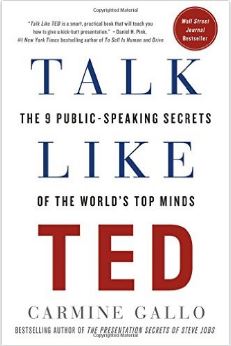
Who’s TED and Why would you want to talk like him?

A Review of
Talk Like TED:  The 9 Public Speaking Secrets of the World’s Top Minds
By: Carmine Gallo


book Cover      It was one of those books that kept appearing in my amazon and audible suggested reading list.  I’m a avid consumer of TED Talks, TED radio hour and local TED X events.   I love learning and 18 minute TED Talks are just enough time to learn a little bit that will hook me into learning more.  I’ve listened to hundreds of TED Talks as I drive from one location to another or weed the garden.  And you know when you find the one TED Talk that changes your perspective or just makes you stop what you are doing and think.  Sometimes I can’t wait to share what I’ve learned with friends and colleagues.  I’ve often wondered why I can explain the concepts and tell the story of some TED Talks like I just listened to them, while others were interesting but I can’t remember them for very long.

In “Talk Like TED,” Carmine Gallo shared why some talks go viral and the ideas stick.  While a sticky idea is an important part of getting people to remember the information, it turns out great public speakers employ several key strategies.  Gallo explained that ideas are the currency of the 21st century and if they are delivered well, they can cause lasting change.

Based on his extensive analysis of TED Talks and presentation strategies, Gallo shared 9 key strategies that will change how you share information in a presentation.  Here’s a very quick overview as I highly recommend you listen to or read his book.  It’s filled with practical strategies.

  1. Unleash the Master within – Find what you love to talk about and share your inspiration.  Your audience will know if you don’t love what you are talking about.  Your passion shows not only in your voice but in your body language.
  2. Tell stories – Gallo noted brain research showed that stories better engage listeners.  They help you connect with your audience by sharing a piece of you.
  3. Practice – There’s no way around it.  Great TED Talks are the result of hundreds of revisions, test runs and practice.  They become a conversation not a lecture.
  4. Teach your audience something new – Humans love novelty and our brains will tune in to learn new things.  So teach them something they didn’t know before.
  5. Deliver jaw-dropping moments – This means sharing something that causes a strong emotional response.  We encode emotionally charged memories better and more accurately. So help your listeners make a connection.
  6. Use humour without telling jokes – It better connects you with your audience.
  7. Stick to about 18 minutes – Much longer and you overload people’s memories and they won’t remember what to share.
  8. Favor pictures over text – we are more likely to recall a picture that a text based bullet.
  9. Stay in your lane – Share your story and what you’ve learned.  People will connect with your authenticity.

Gallo shared personal experiences and numerous TED examples to explain the 9 strategies in a detailed and engaging way that not only makes you think about why some speakers are better able to draw you in, but how you too can share your ideas.

Leadership Connections:

  • Being a leader means sooner or later you are going to have to speak in front of other people in order to share your ideas.  Sharing ideas that connect with an audience requires more than making it up as you go along.  Keeping these 9 ideas in mind can help you shape and refine your presentation skills each time you speak to an audience.
  • Teachers address students each day.  Understanding how to share ideas not only increases the chance that students will remember but it also models presentation techniques.  Just think back to the teacher you remember the most.  I’d wager it’s not the content specifically you remember but how they delivered the content or engaged you in learning that sealed it in your memory.
  • Enhancing your ability to communicate increases the chances that your message is not only heard and understood but that it’s remembered.  Clearly communicating where you are going and how you are going to get there will move your followers forward.


Gallo, C. (2014). Talk Like TED: The 9 Public-Speaking Secrets of the World’s Top Minds. New York: St. Marin’s Press.

Image – Screenshot of the cover from Amazon.ca