A Review of
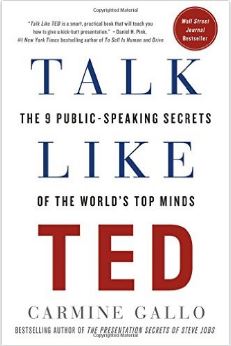
Talk Like TED: The 9 Public Speaking Secrets of the World’s Top Minds
By: Carmine Gallo
It was one of those books that kept appearing in my amazon and audible suggested reading list. I’m a avid consumer of TED Talks, TED radio hour and local TED X events. I love learning and 18 minute TED Talks are just enough time to learn a little bit that will hook me into learning more. I’ve listened to hundreds of TED Talks as I drive from one location to another or weed the garden. And you know when you find the one TED Talk that changes your perspective or just makes you stop what you are doing and think. Sometimes I can’t wait to share what I’ve learned with friends and colleagues. I’ve often wondered why I can explain the concepts and tell the story of some TED Talks like I just listened to them, while others were interesting but I can’t remember them for very long.
In “Talk Like TED,” Carmine Gallo shared why some talks go viral and the ideas stick. While a sticky idea is an important part of getting people to remember the information, it turns out great public speakers employ several key strategies. Gallo explained that ideas are the currency of the 21st century and if they are delivered well, they can cause lasting change.
Based on his extensive analysis of TED Talks and presentation strategies, Gallo shared 9 key strategies that will change how you share information in a presentation. Here’s a very quick overview as I highly recommend you listen to or read his book. It’s filled with practical strategies.
Unleash the Master within – Find what you love to talk about and share your inspiration. Your audience will know if you don’t love what you are talking about. Your passion shows not only in your voice but in your body language.
Tell stories – Gallo noted brain research showed that stories better engage listeners. They help you connect with your audience by sharing a piece of you.
Practice – There’s no way around it. Great TED Talks are the result of hundreds of revisions, test runs and practice. They become a conversation not a lecture.
Teach your audience something new – Humans love novelty and our brains will tune in to learn new things. So teach them something they didn’t know before.
Deliver jaw-dropping moments – This means sharing something that causes a strong emotional response. We encode emotionally charged memories better and more accurately. So help your listeners make a connection.
Use humour without telling jokes – It better connects you with your audience.
Stick to about 18 minutes – Much longer and you overload people’s memories and they won’t remember what to share.
Favor pictures over text – we are more likely to recall a picture that a text based bullet.
Stay in your lane – Share your story and what you’ve learned. People will connect with your authenticity.
Gallo shared personal experiences and numerous TED examples to explain the 9 strategies in a detailed and engaging way that not only makes you think about why some speakers are better able to draw you in, but how you too can share your ideas.
Leadership Connections:
Being a leader means sooner or later you are going to have to speak in front of other people in order to share your ideas. Sharing ideas that connect with an audience requires more than making it up as you go along. Keeping these 9 ideas in mind can help you shape and refine your presentation skills each time you speak to an audience.
Teachers address students each day. Understanding how to share ideas not only increases the chance that students will remember but it also models presentation techniques. Just think back to the teacher you remember the most. I’d wager it’s not the content specifically you remember but how they delivered the content or engaged you in learning that sealed it in your memory.
Enhancing your ability to communicate increases the chances that your message is not only heard and understood but that it’s remembered. Clearly communicating where you are going and how you are going to get there will move your followers forward.
Gallo, C. (2014). Talk Like TED: The 9 Public-Speaking Secrets of the World’s Top Minds. New York: St. Marin’s Press.
A Review of
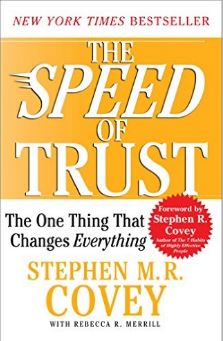
The Speed of Trust The One Thing that Changes Everything
By: Stephen M. R. Covey
with Rebecca R. Merril
Thanks to the Entre Leadership podcasts I was introduced to the value of The Speed of Trust and as Stephen M. R. Covey says it really is the one thing that changes everything. Though not directly mentioned in many leadership theories, it underlies the strength and willingness of your supporters to follow you and produce continuing results. Covey concluded, “I have come to this simple definition of leadership: Leadership is getting results in a way that inspires trust” (p. 40).
Based on personal experience and noted references, Covey takes on the idea that trust is a soft, immeasurable skill with detailed explanations of why it’s really the one skill that affects everyone and everything. From individual to group to organization and to society as a whole, the levels
(Screenshot from Amazon)
of trust we have for each other impact our daily interactions. Covey noted that whether you are leading a group of people or just yourself trust makes a difference. He proceeded in detail to explain the four cores of credibility which include integrity (character), intent (character), capabilities (competency) and results (competency). Integrity comes from the combination of honesty, congruency, humility and courage and our behaviour lets people know where we are at. Intent, why we do what we do shapes our agenda. This too leaks through in our actions.
Covey explained our talents, attitude, skills, knowledge and style (TASKS) make up our capabilities (p.94). The fourth core competency is results. People are going to make decisions about you based on your past, present and potential results. What I appreciate most is that for each aspect Covey presented, he offered concrete ways for you to improve trust. As he mentioned over and over: if trust goes down, then speed goes down and costs go up. When trust goes up, speed goes up and costs go down. He reminded the reader that costs may be financial but they can also be measured in human relationships.
Covey compared trust to a bank account. You can’t just make ongoing withdrawals you have to make trust deposits and he outlined 13 specific behaviours that you can follow to grow your trust account. These included:
Talk Straight
Demonstrate Respect
Create Transparency
Right Wrongs
Show Loyalty
Deliver Results
Get Better
Confront Reality
Clarify Expectations
Practice Accountability
Listen First
Keep Commitments ***
Covey called this the big Kahuna. Fail to follow through on your commitments and it’s the fastest way to break trust. Don’t say you will if you can’t (p. 215). I would say you are safer to under promise and over deliver.
Extend Trust
I appreciate Covey’s honest approach to sharing both public and personal stories and by including both positive and negative example of why trust matters. As I read through this book I shared my readings with those I crossed paths. While they often nodded and agreed that yes it made sense. I think many people, including leaders often think we don’t need to work on trust we already have it. As I reflect, I wonder how often we as leaders (myself included) stop to ask our team members how they feel or do I make an assumption for them about trust levels? In the end, leaders only have the opportunity to lead because of their followers. It’s leaders interactions with people and their intent behind their interactions that strengthens or weakens the relationships. As Covey asserted several times, trust “is the key leadership competency of the new global economy” (p.107). Do you know where your trust account is at?
Leadership Connections:
I appreciated the practical steps and strategies that Covey explained in his book. Whether you are leading a huge team or looking to improve your self trust, this book is filled with useful strategies you can choose to apply in your own life.
It’s not a one time listen. I first listened through audible and later purchased the book as a way to continue to go back and reference the key ideas. I’ve found the supporting website helpful at reminding me of key aspects of the book along with online surveys and resources to support further development.
The more I learn about leadership the clearer it is that while the traits of a leader are an important part of leadership the theories which include the role of the follower are extremely significant. True, healthy, effective leadership that produces tangible results will increase only when a leader truly makes an effort to lead his/her followers in a way that not only meets their needs but inspires them to commit to higher levels of engagement. Leadership is a two way street and we are all on it together.
Covey, S. M. (2006). The SPEED of Trust: The One Thing that Changes Everything. New York: Free Press.
While not specifically directed at the concept of leadership, Chip & Dan Heath shared straightforward strategies for dealing with change and making it last. It’s a challenge often faced by leaders, whether you are leading a cross country team, a class of students or your own family. Making the change not only stick but have noticeable results is a skill worth learning. Written to include practical strategies enhanced by real life examples, the Heaths offer practical ways to address the changes in your life based on research compiled from a variety of disciplines including psychology and sociology. It’s one of my all time favourite audio books. The stories keep you engaged and help you to remember the key points.
The Heaths explain that everyone of us has two sides and use the comparison of a rider on an elephant to help you better understand how the brain works. The rider is the rational part and the elephant is the emotional response. In order to make change stick you need to get the rider and elephant going in the same direction. Chip and Dan Heath outlined three key parts to successful change. First, you must direct the rider. I was drawn to the research they shared that when we focus on the bright spots or what’s working, we begin to see more ways to make the change work. In short, focus on the positive examples. Yes we can learn from the negatives but research shows focusing on the positives will generate better results.
Second, you have to motivate the elephant. You will exhaust the rider if you don’t get them both going in the same direction. Willpower only lasts so long. The Heath’s noted several examples, but what stuck in my mind is that identities can change. What type of identity and growth mindset is linked to your team? The innovator identity of Brasilata stands out in my as a powerful example of how changing the mindset of your team can truly transform the long term results for the better. What type of growth mindset do you carry with you?
Lastly, you have to shape the path. Do you realize that it’s not always the people that are the problem? The Heaths noted Lee Ross’s fundamental attribution error research that is our “inclination to attribute people’s behavior to the way they are rather than the situation they are in” (p. 180). If you tweak the environment, the situation, the context… how people respond changes.
It’s well worth the page turning read. The Heaths share big business, education and personal examples of how these strategies can make a difference. As with anything these research based suggestions aren’t a quick fix and you have to commit to leading the change; however, this book offers practical ways to reflect and shape the change happening around you. Whether or not you want to do the work is up to you.
Leadership Connection:
Leaders are often called upon to lead the change or implement the initiatives. Regardless of whether or not you are the president of the company or an employee, the skills you use to cope with change ripple out to those around you. The opportunity to build your toolbox and help others grow through change will change your relationship with others.
As an educator, the strategies offered here are applicable within a classroom, school or division level; moreover, teaching your students to navigate change will be one of the most valuable skills they can take with them into their future.
Additional Resources:
At heathbrothers.com you can register for a variety of free resources that highlight key aspects of the book including a summary pdf, workbooks and podcasts.
Heath, C., & Heath , D. (2010). Switch How to Change Things When Change is Hard. Toronto: Random House Canada.
Why is Super Better on a list of leadership resources?
A Summary of Super Better
By: Jane McGonigal
Super Better is one of my all time favourite reads because it changes how you look at the world around you and the opportunities you have to build your resilience. Based on the idea of being gameful, Jane shares her own story of how the Super Better game began as Jane the Concussion slayer in response to her own severe concussion and subsequent depression. In her book and TED Talk, Jane shared how she used the science of games to create her own daily challenges to help get better.
Built around the idea that improving your physical, social, emotional and mental resilience will improve your overall health and perspective on life, Super Better uses strategies found in gaming to increase your strength, happiness and resilience (p. xi). Did you just make a face when I mentioned gaming? Don’t worry it’s not going to try to make you into a gamer rather it pulls from rigorous game based research, which means using what science has learned about gaming to help you become healthier. Can you play it as a game? Yes – there’s an app for that – SuperBetter.com. What you don’t want to miss is the wealth of strategies offered that have the potential to improve your resilience.
McGoningal (2015) noted in her opening pages, “there’s a lot of evidence that it works” (p. xi) including a “randomized, controlled study conducted by the University of Pennsylvania…[and] a clinical trial funded by the National Institutes of Health and conducted at Ohio STate University Wexner Medical Center” (p. xi). A summary is available at the end of the book and online at showmethescience.com
Are you intrigued? Here’s the very quick rundown of SuperBetter. Based on the idea of post-traumatic and post-ecstatic growth… which means why do some people grow stronger after extreme stress while others are weakened (p. 7). McGonigal noted 7 key ways of “of thinking and acting that contribute to post-traumatic and post-ecstatic growth. And they are all ways that we commonly think and act when we play games” (p. 7-8).
Learn the skill of benefit finding
(SuperBetter, p. 8-9)
The SuperBetter method helps you learn how to challenge yourself in a variety of ways that you can easily do each day. My favourite are “power-ups” – “any positive action you can take, easily that creates a quick moment of pleasure, strength, courage or connection for you” (p. 160). McGonigal goes on to share that these will change your “biology in extraordinarily important and long-term ways” (p.160) making you less vulnerable to stress.
Power-ups are easy and can be physical, social, emotional or mental. It can be standing up and taking 3 steps or snapping your fingers 50 times. Building resilience helps your body withstand stress (physical p. 14); “improve focus, motivation and will power” (mental p. 15); increase your ability to focus positive emotions (emotional p.16); and find support in the networks around you (social p.17). The book is filled with examples of power-ups and the online game includes more designed both by McGonigal and other players.
Power-ups build into quests – things may push you outside your comfort zone but are achievable in the next 24 hours. It just like teachers would do for their students. Challenge them to stretch to what is in reach but just outside where they’ve been before. Then you build your network of allies….what leader doesn’t need a team of strong followers. You go on to name your own bad guys and develop your own super hero name in the ultimate search for your epic win. Even if you are shaking your head right now, remember that each aspect has the science behind it… including giving yourself your own secret identity.
So why talk about Super Better in a class that’s focusing on leadership? As an educator and a home based business team leader, I see many benefits to building these strategies into your daily life. Can you imagine if we explicitly planned in schools to create more resilient students? Not that teachers don’t already do this, but what if we purposefully use research based strategies to build resilient learners. Could you imagine the toolbox of resilient strategies students would have? Can you imagine the ripple effect?
Whether you are a team leader in business or a teacher in a classroom, what you do and how you do it affects your followers. It affects how your followers are going to respond to tough times and hard decisions, which in turn affects how they support you as a leader. Leadership is more than having the characteristics of a leader, it’s about how you can give back to your team members. After all, a resilient team that builds on the strengths of each other and forms a strong supportive network is more likely to produce positive results.
And so as I write this near the beginning of my ETAD 898 – Independent Study in Leadership, I see connections building to theories of servant and transformational leadership. I think SuperBetter offers a concrete, research based way for you to become more resilient and in turn you have the opportunity to share those strategies with those around you.
My daughter is 7 and we’ve started playing SuperBetter together. It’s a great way for us to learn how to live healthier together. Even better, she reminds me to do our power-ups and when she’s had a tough day we stop for a moment and look at all the positive power-ups that she’s already done and at ones that will help us feel better.
So whether you play the game faithfully or learn some simple strategies. There’s always something to learn from the SuperBetter method.
SuperBetter: A Revolutionary Approach to Getting Stronger, Happier, Braver and More Resilient – Jane McGonigal
If you teach them how to share it’s more than fair!
This week the Great EdTech debate challenge fell to our team. We represented the Disagree side of the debate which focused on: Openness and sharing in schools unfair to our kids.
If you are interested here’s our opening arguments.
As I first read through the questions, I wondered is it fair not to share? Teaching in and of itself is sharing of knowledge. Our goal as educators is to share our knowledge of a concept in a variety of ways that encourages deeper understanding in our students. As Wiley and Green (2012) pointed out in Why Openness in Education, we even judge educators on their ability to share and impart understanding to students (para. 5 & 6).
So sharing is part of what we do as educators…. rather it’s the what, how and where we share that we really need to think about? If you think back to when you were growing up, some of us perhaps, didn’t have to worry about the photo someone snapped at a gathering or comment that was shared. Our networks were smaller. Perhaps your embarrassing photo made the yearbook or a friend actually had the roll of film developed. The chances of widespread distribution and repercussions were on a smaller scale. Now don’t get me wrong, it wasn’t fun if the wrong person got a hold of a photo or some how continued to share things. It wasn’t however on the same scale as social media provides today. So keep in mind that many of us who are now parents didn’t grow up in a world with social media or cell phones (mobile phones came in bags and you could only use then in case of emergency because who could afford the cost per minute).
Is the answer to attempt to remove technology from our lives and avoid any device that could capture our image so that facial recognition software can’t identify us? I guess you can try but for the large majority of us it’s not practical; moreover, sticking our head in the proverbial sand won’t make the issue go away, but someone might make a nice meme out of it.
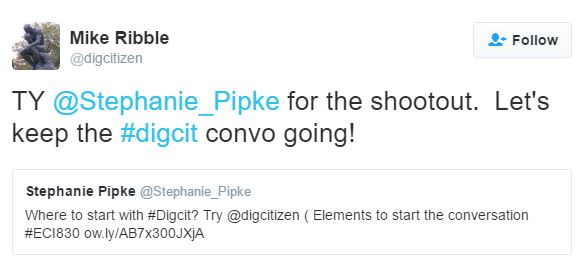
In my experience it’s about having the courage to step into the conversation with students and talk about what’s going on. Is oversharing happening? What type of images are being posted? What if you just like or comment – does that make you part of it? It also means that we need to model or attempt thoughtful digital citizenship the best we can. This means that we need to know what engaged, thoughtful digital citizens do. While we may not all have access to Digital Learning Consultants and I have to say thank-you to Thad, Kirk and Robert for their ongoing encouragement and support during my years as a teacher and consultant. It makes a difference to have knowledgeable and reflective people to talk to about digital issues. So as the Agree team mentioned during the debate, we live in the real world and ongoing to access to PD and support people may not always be possible; however, we do live in an age where there is ample helpful information online about digital citizenship and digital footprints. I first learned about the elements of Digital Citizenship on Mike Ribble’s website.
What about oversharing? You know it’s going to happen and it’s like a digital tattoo. It has the potential to fade but never really go away. How do you prevent it? I think it begins with open communication with our children. As educators and parents, we have a great opportunity to talk about the pictures we take and how we share them. When you snap that pic and post it to Facebook, do you talk to your child about where you are posting it? Am I posting it publicly for everyone to see on my profile or am I sharing it with a select group of people in a secret Facebook group? Think about the conversation potential that exists with our Pre-K and K teachers as they document and share student learning with parents. I’ve seen our early learning teachers engage in thoughtful conversations about what they are sharing and who will see it. As a parent, I really appreciate getting the updates of what my daughter is doing in class. Plus hearing her voice as she explains it is priceless. Sharing matters.
Worried about oversharing? It’s happening all around us and it may be impacting our lives more than we know.
On the flip side, I remember back to a time when I was co-teaching my Bio 30 class with a teacher of a grade 5 class in a different community. We skyped everyday and each grade 12 was paired with a grade 5 student in the 1:1 learning project. We talked often about the expectations and how we needed to be engaged digital citizens, yet a grade 5 overshared info – nothing earth shattering but enough that the Bio 30 student was concerned. What it did do was generate a healthy discussion about what was appropriate to share in our wikispace discussions and how we can learn from the experience. We were working in a safe private space, so it was a great learning opportunity for all of us. One that will hopefully remind us all to think before we share.
So starting the conversation early will help engage students and teachers in thoughtfully sharing positive experiences to grow their digital footprint, which in turn helps model the practice to parents and family that may not have considered those aspects. Kathy Cassidy shared in her video that yes what we share in social media is permanent but because of that it’s a great way to look back and see how much we have grown. She also talked about the value of modeling how to use social media and in doing so how we influence student’s understanding of the world and practice empathy.
Steven W. Anderson shared Meredith Stewart’s tweet, “If you aren’t controlling your footprint, others are.” He encouraged readers to start building their brand – their digital identity. You do this by sharing and creating positive online footprints, but as the Agree team pointed out – you need to watch out for bouncing. When a photo that you have shared gets used for something else. As Anderson pointed out, not only do you have to actively build a positive identity you have to monitor it. Alec Couros noted in our follow up conversation that just googling our names doesn’t truly include all of our digital footprint. We need to consider the data that is tracked in all the apps that we use.
Alec discussed how facial recognition technology is now available and when he showed us how it worked with his own images, we realized just how many people there are out there that look just like him. (I mean exactly like him! They in fact are using one of his photos as their profile picture). We have to learn how to be aware of the footprints we are actively creating, as well as those that are being created without our consent.
Should all of this scare you as an educator away from sharing? or considering the sharing of student work? It’s important to consider the positive impacts of sharing. Rather than only relying on standardized assessments to ensure academic standards are being met.Bence asked “what if learner work were shared on a wider level so that the work could speak for itself. She shared examples of how being transparent with what’s happening in the classroom has added “another layer of authenticity to education” (para. 4). Learners have become more active participants in their own education especially when they know the audience is more than just the classroom. As with any online venture in education, Bence encouraged educators to check with their schools and districts to ensure practices align with responsible use.
Here’s part of our closing arguments from Tuesday night – sharing matters and it’s important to teach our children how to share.
You are welcome to check out our team’s resource list. We’ve selected a number of articles and guides to help educators grow their understanding of sharing.
What will matter in the future as our Facebook babies grow up and realize just what their parents and teachers have shared? I can only imagine where we will be when I think about how things have evolved in the first half of my teaching career… or even in the last 5 years for that matter.
What matters today is that we start the conversation. Hopefully if we start today and engaging in ongoing conversations about digital citizenship, we will all learn to pause before we post and think about the potential ripple effect.
Regardless of social media or old fashioned information sharing asking ourselves the following question will impact how we try to live our lives.
What legacy do you want to leave behind?
Special thanks to Lisa and Haiming! What a great team – glad to have had the chance to work with you!
As I’ve had a chance to read through other blog posts, these are a few that have stood out to me:
Jeremy B explained we all need to engage in digital citizenship education. He suggested introducing it to parents at meet the teacher nights as a way to engage parents. He noted that it’s also about sharing the resources we have with parents.
Erin B shared her decision to share student work using Seesaw and how she shared expectations with parents and students. It’s making the time to explicitly teach the students about digital citizenship and then apply it to their learning that truly makes a difference. Learning about digital citizenship in authentic situations truly makes a difference.
I really enjoyed Amy’s blog post. In particular, she referenced a an article by Geddes that questioned how quickly we post. She pointed out that when we had to go to our computers, log in, find the photo, upload, add the comment and then post – that we were more thoughtful. Has tech made it so easy that we’ve eliminated our thinking time?
Justine – made a very interesting point – our digital footprints can change as our names do which build on the conversation started by Amy S. I also agree that sharing a letter home with parents that invites them to participate and be aware of the social media use in a classroom is important. If you remember Mark Prensky’s Digital Natives vs. Digital Immigrants articles, Justine shared a great way to think of the differences in ways that we use the internet as Digital visitors vs Digital Residents. She also shared this quick video.
Just listed to Alec’s TED X Talk. A very thoughtful look at the value of understanding our digital identity and just how connected we are. Lots of great ideas to think about here.
Tyler’s post Unfair? Nope.pointed out the value of helping students learn about digital citizenship and have the opportunity to practice it. Plus he also shares some very helpful resources.
Luke’s post about “The More We Share, the More we Have” raises many thoughtful points about why we share what we do and the value included in it. You’ll also want to check out the oversharing video – well worth the watch.
Kelsie shared many great points but when she shared the Terms of Service – Didn’t read it website things got really interesting.

 It was one of those books that kept appearing in my amazon and audible suggested reading list. I’m a avid consumer of TED Talks, TED radio hour and local TED X events. I love learning and 18 minute TED Talks are just enough time to learn a little bit that will hook me into learning more. I’ve listened to hundreds of TED Talks as I drive from one location to another or weed the garden. And you know when you find the one TED Talk that changes your perspective or just makes you stop what you are doing and think. Sometimes I can’t wait to share what I’ve learned with friends and colleagues. I’ve often wondered why I can explain the concepts and tell the story of some TED Talks like I just listened to them, while others were interesting but I can’t remember them for very long.
 Thanks to the Entre Leadership podcasts I was introduced to the value of The Speed of Trust and as Stephen M. R. Covey says it really is the one thing that changes everything. Though not directly mentioned in many leadership theories, it underlies the strength and willingness of your supporters to follow you and produce continuing results. Covey concluded, “I have come to this simple definition of leadership: Leadership is getting results in a way that inspires trust” (p. 40).
 McGoningal (2015) noted in her opening pages, “there’s a lot of evidence that it works” (p. xi) including a “randomized, controlled study conducted by the University of Pennsylvania…[and] a clinical trial funded by the National Institutes of Health and conducted at Ohio STate University Wexner Medical Center” (p. xi). A summary is available at the end of the book and online at
 What's Your Story?