Body Language- What you are really saying…

Your Body Language Shapes Who You Are ~ Amy Cuddy

TED Talk
Interactive Transcript

One of my favourite TED Talks, okay I have lots of favourite TED Talks.  It turns out what you can learn in 18 minutes truly change your life.  This one in fact has impacted my daily interactions and lead me to attend more workshops on non-verbal communication.  Did you know how you carry yourself and how you stand can change not only the way you think about yourself but the hormone levels in your body?  Strong leaders are able to clearly communicate their message and this includes the non-verbal aspects, as well. I do have to warn you, once you learn more about body language it has the potential to change the way you see the world.  Do you think two minutes of power posing can change how you feel? Are you ready?

Cuddy noted in her 2012 TED Talk that “we make sweeping judgement and inferences from body language” (time 2.04).  From deciding whether or not we like someone, to whether a physician is nice (turns out nice Doctors are sued less often) or if we will vote for a political candidate,  those seconds before you speak shape lasting impressions. As a social scientist, Cuddy wondered “do our nonverbals govern how we think and feel about ourselves?” (time 6:57). Can you fake till you make it?

By examining levels of “testosterone, which is the dominance hormone, and cortisol, which is the stress hormone” (time 7:57), Cuddy tracked hormone levels in both powerful and powerless people.  Research showed that “powerful and effective leaders also have high testosterone and low cortisol” (time 7:57). Based on her team’s experiments, Cuddy had people pose in high power and low power poses for two minutes prior to the testing of hormone levels and then in the second experiment an independent panel of body language experts evaluated them during an intense interview.  What she found was that 2 minutes of power posing (think wonder women) changes your hormone levels.  Power posing increases testosterone and decreases cortisol, whereas weaker poses like hunching over and checking your phone in the waiting room have the opposite effect (Time 11:44).

Cuddy explained “that our bodies can change our minds and our minds can change our behaviour, and our behaviour can change our outcomes” (15:35). Anyone can be a leader but part of that is in our minds.  People respond to our non verbal communication, so paying attention to the signals you are sending makes a difference in the congruency of the messages you convey.  As Amy Cuddy says, “don’t fake it till you make it.   Fake it till you become it” (time 19:14).

Leadership Connections: 

The more I learn about body language the more I understand how  nonverbal communication impacts our daily interactions.  Many leadership theories talk about the charisma and other dominant characteristics of leaders, while only a few acknowledge body language directly.  It’s importance is embedded into every interaction a leader has with a follower.  In fact, Cuddy explains that if one person has bigger body language the other person doesn’t mirror it rather they do the opposite and become smaller (4:55). Learning how to read the nonverbal signals in the room isn’t easy and learning how to respond is even harder but in the end your conscious body language choices will become more automatic and you will change your relationships with those around you.

Now imagine yourself as a teacher or team leader that’s aware of  body language.  The ability to consciously share the strategies with those around you has the potential to change their self-confidence. It has the potential to transform your team.


TED Talk – Your Body Language Shapes Who You Are – Amy Cudy
Interactive Transcript
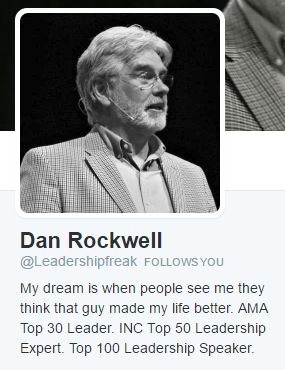


One of My Favourite Leadership Blogs – Leadership Freak

As I continue my search for Leadership resources and practical strategies to build strong teams and future leaders, I’m drawn back to one of my favourite blogs.  Leadership Freak  by Dan Rockwell designed, as he noted in his info, to empower leaders 300 words at a time.  And that’s what I’ve come to appreciate and am always working at improving.  The ability to shTwitter Picare useful information in a concise yet engaging fashion.  It’s what Dan Rockwell does each day.

Since January of 2010, Dan Rockwell has been sharing his ideas on leadership ranging from how to deal with underhanded resistance to servant leadership and coaching to name a few. Each offering ways to reflect on and move forward as a leader. If you are a regular reader you will also find there are opportunities to listen in to guest speakers, as well as, great recommendations for leadership resources.

So if you’re wondering about a topic and what thoughtful read that will get you thinking, the Leadership Freak blog is a great place to start.

(Image Twitter Screenshot – July 2016)


Switch – Why you want to add this to your leadership toolbox.

A Summary of

Switch How to Change Things When Change is Hard

By: Chip Heath and Dan Heath


While not specifically directed at the concept of leadership, Chip & Dan Heath shared straightforward strategies for dealing with change and making it last.  It’s a challenge often faced by leaders, whether you are leading a cross country team, a class of students or your own family.  Making the change not only stick but have noticeable results is a skill worth learning.  Written to include practical strategies enhanced by real life examples, the Heaths offer practical ways to address the changes in your life based on research compiled from a variety of disciplines including psychology and sociology. It’s one of my all time favourite audio books.  The stories keep you engaged and help you to remember the key points.

The Heaths explain that everyone of us has two sides and use the comparison of a rider on an elephant to help you better understand how the brain works.  The rider is the rational part and the elephant is the emotional response.  In order to make change stick you need to get the rider and elephant going in the same direction.  Chip and Dan Heath outlined three key parts to successful change.  First, you must direct the rider.  I was drawn to the research they shared that when we focus on the bright spots or what’s working, we begin to see more ways to make the change work.  In short, focus on the positive examples.  Yes we can learn from the negatives but research shows focusing on the positives will generate better results.

Second, you have to motivate the elephant.  You will exhaust the rider if you don’t get them both going in the same direction.  Willpower only lasts so long.  The Heath’s noted several examples, but what stuck in my mind is that identities can change.  What type of identity and growth mindset is linked to your team?  The innovator identity of Brasilata stands out in my as a powerful example of how changing the mindset of your team can truly transform the long term results for the better. What type of growth mindset do you carry with you?

Lastly, you have to shape the path.  Do you realize that it’s not always the people that are the problem?  The Heaths noted Lee Ross’s fundamental attribution error research that is our “inclination to attribute people’s behavior to the way they are rather than the situation they are in” (p. 180). If you tweak the environment, the situation, the context… how people respond changes.

It’s well worth the page turning read.  The Heaths share big business, education and personal examples of how these strategies can make a difference.  As with anything these research based suggestions aren’t a quick fix and you have to commit to leading the change; however, this book offers practical ways to reflect and shape the change happening around you.  Whether or not you want to do the work is up to you.

Leadership Connection:

  • Leaders are often called upon to lead the change or implement the initiatives.  Regardless of whether or not you are the president of the company or an employee, the skills you use to cope with change ripple out to those around you. The opportunity to build your toolbox and help others grow through change will change your relationship with others.
  • As an educator, the strategies offered here are applicable within a classroom, school or division level; moreover, teaching your students to navigate change will be one of the most valuable skills they can take with them into their future.

Additional Resources:

  • At heathbrothers.com you can register for a variety of free resources that highlight key aspects of the book including a summary pdf, workbooks and podcasts.

Heath, C., & Heath , D. (2010). Switch How to Change Things When Change is Hard. Toronto: Random House Canada.


Summary – Leadership Theory & Competency Frameworks

Summary of
A Review of Leadership Theory and Competency Frameworks


By. R. Bolden, J. Gosling, A. Marurano and P. Dennison
June 2003
(PDF)

If you are looking for a quick overview of leadership theories, Bolden, Gosling, Marurano and Dennison succinctly review the key points of a variety of leadership theories ranging from trait based through to transformational leadership.  Each section provided a quick summary of the key theoretical aspects and touched on a variety of leadership theories including:

  • trait based leadership
  • behavioral
  • situational
  • contingency
  • transactional
  • transformational

Of interest is how the focus of the research has expanded to not only include the leader but the followers and situational context.  The authors noted that there is no one size fits all leadership style and each theory lends itself to different styles, followers and situations (p. 8).   Bolden et. al. reviewed several leadership models and competency frameworks by notable organizations such as Federal Express, Lufthansa, Shell, Ministry of Defence, and the National College for School Leadership.  Each framework highlighted priorities and characteristics unique to its developing company, yet there were many similarities when you moved beyond the choice of language descriptors.

Bolden et. al. selected and briefly over viewed six leadership development initiatives each designed to develop certain characteristics in their participants.  This section provided links for follow up.  Next, the authors examined how to provide governance to the different roles within legal and ethical frameworks.

Lastly, Bolden et. al. reminded us to be thoughtful when considering leadership theories as many theories fail to mention the role of the followers and the complimentary leadership skills needed for success. I agreed with their conclusion that many leadership attributes have been identified and frameworks developed but most importantly the value lies in the process of developing a model.  What seems to be missing in much of the leadership reading that I have done so far is as Bolden et.al. noted.  Where do we go once theories and frameworks have been developed?  What are the highest impact strategies that help build effective leadership? And is the process ever really finished or does the framework continually need to evolve?


Although somewhat dated (June 2003), the most helpful part of this article  for me was the overview of theories at the start and reflection on leadership at the end.  As I read through each theory, I began to see connections to both the education and business worlds in which I work.  Each perspective offers an insight into characteristics that will enable you to be considered more leader like, but each theory’s strengths apply to different types of situations, followers and organizations.  Perhaps it’s my eclectic learning style, but at this point I’m most likely to add the relevant points from a variety of theories to my leadership toolbox.  Leadership and what makes a person a leader is much more complicated than it first appears.

I wonder how often we stop to think about why we follow the leaders we do and does who we follow say more about us than the leaders themselves?


Bolden, R., Gosling, J., Marturano, A., & Dennison, P. (2003). A Review of Leadership Theory    and Competency Frameworks. Crossmead: University of Exeter. Retrieved from http://www.fcsh.unl.pt/docentes/luisrodrigues/textos/Liderança.pdf

Summary of Leadership Styles in Synchronous and Asynchronous Virtual Learning Environments

A Summary of
Leadership Styles in Synchronous and Asynchronous Virtual Learning Environments


Article By
Stefano Ruggieri, Stefano Boca and Maria Garro (PDF)

There is a difference.  Face to face leadership is different than virtual leadership.  Ruggieri, Boca and Garro highlighted that while face to face leadership is established through physical presence including “body language, vocal inflection, eye contact and clothing” (p. 98) along with comments from inside the group. Virtual leaders are challenged by the technology. “The medium forces the leader to adopt other indicators to let followers know he/she is in charge, which include frequency of intervention, small delays between request and responses, being (almost) always available” (p. 96).  How you recognize the leader happens in different ways online.

Ruggieri, et. al. noted that virtual team research reinforced that transformational leadership develops higher levels of “trust, performance and job satisfaction compared to those of transactional leadership”(p.97) yet it’s still lower than face to face situations. Virtual communication occurs synchronously in real time through video conferencing or live chats or asynchronously at different times through discussion threads or email (p. 97-98). The authors noted text based communication as the most commonly studied medium. Text has many positives including the capability to enable many people to contribute at once (p. 98).

A good reminder for all of us is the caution that typing speed along with the ability to decode and read can significantly influence a person’s ability to participate, which may not be indicative of their ability to contribute to the group but of a language barrier (p. 98).  An important reminder for all of us as educators of EAL students and for team leaders with large cross country teams.  Our preferred medium may be text but not everyone may be able to fully participate and contribute.

The authors explained Henri’s method for examining the 5 dimensions of the learning process through online communication because not only are the number and frequency of messages important, but the meaning and learning embedded within the exchanges. Ruggieri, Boca and Garro studied synchronous and asynchronous communication within text based problem solving groups with transactional and transformational leaders.

The researchers noted online groups led by a transformational leaders resulted in”an increased level of cognitive and metacognitive communications” (p. 100) which in turn led to leader behaviour which encouraged self awareness and personal growth, as well as, enhanced levels of “proactive personality and team identification” (p. 101).  Because the transformational leader builds the skills of the followers, they “have the ability to influence the emotional climate of the work group” (p. 101).  The chosen interactive medium is a tool that also shapes group communication differently than face to face interactions.

Overall, Ruggieri, Boca and Garro provide an insightful look into the world of virtual leadership and how your online leadership style has the potential to affect motivation and effectiveness of your team.

As a team leader, I’ve often wondered how to lead online and this article provided an interesting look into how technology impacts our communication, leadership and in turn our team results.  Whether it’s a large scale home based business Facebook group or a ETAD discussion forum, leaders will emerge.  The groups I’ve most enjoyed follow a transformational style where I’m inspired to join in and participate rather than because I have to.  As I reflect back on 9 online classes, some of our most insightful, interactive and asynchronous conversations have developed in our groups with transformational leaders that encouraged us to share our ideas without the fear of being wrong.  For the real learning is in the sharing of and reflecting on ideas.  You don’t grow unless you share, make connections and think more deeply.


Ruggieri, S., Boca, S., & Garro, M. (2013, October). Leadership Styles in Synchronous and Asynchronous Virtual Learning Environments. The Turkish Online Journal of Educational Technology, 12(4). Retrieved from http://files.eric.ed.gov/fulltext/EJ1018022.pdf