Who’s TED and Why would you want to talk like him?

A Review of
Talk Like TED:  The 9 Public Speaking Secrets of the World’s Top Minds
By: Carmine Gallo
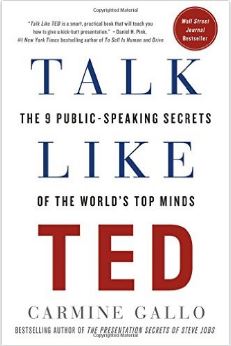

book Cover      It was one of those books that kept appearing in my amazon and audible suggested reading list.  I’m a avid consumer of TED Talks, TED radio hour and local TED X events.   I love learning and 18 minute TED Talks are just enough time to learn a little bit that will hook me into learning more.  I’ve listened to hundreds of TED Talks as I drive from one location to another or weed the garden.  And you know when you find the one TED Talk that changes your perspective or just makes you stop what you are doing and think.  Sometimes I can’t wait to share what I’ve learned with friends and colleagues.  I’ve often wondered why I can explain the concepts and tell the story of some TED Talks like I just listened to them, while others were interesting but I can’t remember them for very long.

In “Talk Like TED,” Carmine Gallo shared why some talks go viral and the ideas stick.  While a sticky idea is an important part of getting people to remember the information, it turns out great public speakers employ several key strategies.  Gallo explained that ideas are the currency of the 21st century and if they are delivered well, they can cause lasting change.

Based on his extensive analysis of TED Talks and presentation strategies, Gallo shared 9 key strategies that will change how you share information in a presentation.  Here’s a very quick overview as I highly recommend you listen to or read his book.  It’s filled with practical strategies.

  1. Unleash the Master within – Find what you love to talk about and share your inspiration.  Your audience will know if you don’t love what you are talking about.  Your passion shows not only in your voice but in your body language.
  2. Tell stories – Gallo noted brain research showed that stories better engage listeners.  They help you connect with your audience by sharing a piece of you.
  3. Practice – There’s no way around it.  Great TED Talks are the result of hundreds of revisions, test runs and practice.  They become a conversation not a lecture.
  4. Teach your audience something new – Humans love novelty and our brains will tune in to learn new things.  So teach them something they didn’t know before.
  5. Deliver jaw-dropping moments – This means sharing something that causes a strong emotional response.  We encode emotionally charged memories better and more accurately. So help your listeners make a connection.
  6. Use humour without telling jokes – It better connects you with your audience.
  7. Stick to about 18 minutes – Much longer and you overload people’s memories and they won’t remember what to share.
  8. Favor pictures over text – we are more likely to recall a picture that a text based bullet.
  9. Stay in your lane – Share your story and what you’ve learned.  People will connect with your authenticity.

Gallo shared personal experiences and numerous TED examples to explain the 9 strategies in a detailed and engaging way that not only makes you think about why some speakers are better able to draw you in, but how you too can share your ideas.

Leadership Connections:

  • Being a leader means sooner or later you are going to have to speak in front of other people in order to share your ideas.  Sharing ideas that connect with an audience requires more than making it up as you go along.  Keeping these 9 ideas in mind can help you shape and refine your presentation skills each time you speak to an audience.
  • Teachers address students each day.  Understanding how to share ideas not only increases the chance that students will remember but it also models presentation techniques.  Just think back to the teacher you remember the most.  I’d wager it’s not the content specifically you remember but how they delivered the content or engaged you in learning that sealed it in your memory.
  • Enhancing your ability to communicate increases the chances that your message is not only heard and understood but that it’s remembered.  Clearly communicating where you are going and how you are going to get there will move your followers forward.


Gallo, C. (2014). Talk Like TED: The 9 Public-Speaking Secrets of the World’s Top Minds. New York: St. Marin’s Press.

Image – Screenshot of the cover from Amazon.ca
 

What or Who causes ideas to tip?

A Review of
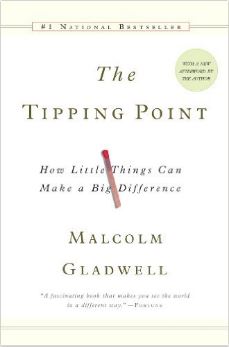
The Tipping Point: How Little Things Can Make a Big Difference
By: Malcom Gladwell


book coverJust as the title promised, Gladwell explained how it’s the little things over time that make the difference and in the end cause the change to tip.  Despite being written in 2006, the basic ideas still resonated strongly with me and added to my perspective of how change comes to be in the world around us. As leaders, The Tipping Point reminded us to appreciate the people in our network and value the the small changes because in the end it’s more often the combination of small consistent changes that have shaped the world around us than large sweeping initiatives.
Gladwell skillfully uses real life case studies and stories to engage the reader in an interesting journey through the evolution of an idea.   He compared an idea to that of an epidemic.  One moment or perhaps for years it’s just an idea or how things have always been and then it hits the tipping point and everything changes. He referenced New York City’s drop in crime and why Paul Revere’s ride changed history and the other guy’s didn’t.  Did you know there was another rider that tried to warn of the British invasion?  By encouraging us to reflect on the world around us, Gladwell opened our minds to the possibilities of change and helped us understand why some ideas spread. He also noted the factors that help ideas catch fire.

It seems simple that good ideas will spread.  People get excited, they share their ideas and the effect ripples out.  It would be interesting to read an updated afterword by Gladwell based on the changes in social media in the last 10 years, but I imagine he’d say the same types of people still exist.  It’s just their medium and perhaps sphere of influence that has broadened.

“The success of any kind of social epidemic is heavily dependent on the involvement of people with a particular and rare set of social gifts” (p. 33).  That is the law of the few.  Gladwell explained that there are three key types of people in our world. Connectors, Maven and Salesmen.

Connectors are those in our networks that know lots of other people and their networks cross into many different types of social circles.  They enjoy bringing people together from different circles and introduce you.  Gladwell encouraged the reader to pause for a moment and think about your friends.  How did you meet them?  Who introduced you? More than likely, there’s one or two people that made those connections.   As an introvert, connectors are very important people to me.  They eliminate the need for small talk and connect you with people without requiring the extra energy it takes to meet strangers.  When you are brought together by a connector, you already have something in common to talk about.

Mavens are the “people we rely upon to connect us with new information” (p. 19) about specific topics. They are passionate about the topic they care about and you trust their advice. Just think about it.  Who’s your tech person?  Who recommends the best places to eat? Who do you ask when your car doesn’t work?  We all know mavens.  They want to share and they are often skilled communicators.

Lastly, Gladwell referred to the salesmen or those who are good at persuading.  Not only are they skilled verbal communicators, their body language seals the deal.  Interestingly, Gladwell mentioned the role of body language and the subtle ways these people exude persuasive body language.

Share your idea with one of these people and the chance of it spreading greatly increases, however, just sharing the idea won’t cause a word of mouth epidemic. He explained the message has to stick.  If people don’t remember it, they won’t share it.

What truly resonated with me, partially because the idea has come up in several other reads, was the power of context. People’s behaviour is reflective of the type of environment that’s been created.  It’s what he called the broken windows effect.  In short if we walk down a street with dilapidated old buildings, dark alleys, filled with garbage and lots of broken windows, we will act differently. The theory suggested that you will also see a higher violent crime rate.  Literally, clean up your streets and your crime rate will drop.

Filled with moving examples, Gladwell repeatedly draws the connections back to case studies and the complimentary research in a way that is sure to keep you turning the pages. It increases your awareness of the change happening around you and the next time something tips…maybe you’ll spot one of the reasons why.  Interestingly, Gladwell explained it’s not the huge changes that cause ideas to spread it’s the small, consistent actions that happen everyday that build into lasting change.

Leadership Connections:

  • What’s this have to do with being a leader?  Change is always happening.  As a leader, we are often asked to move change forward.  Understanding how change works and how you can tip change in a positive way, increases your chances at successfully reaching your goal.  Whether you want to improve your school or lead an effective team, understanding change will help you better support your team.
  • Do you know your people?  Can you spot the connectors, mavens and salespeople on your team?  The diversity of your team is an asset on which you can build the skills of everyone.
  • Understanding the value of the tipping point means that you don’t have to stand at the front and lecture people on what to do.  You need to come up with a sticky idea and shape the environment and then work with your team.
  • Gladwell offered interested readers the gateway to working on change. If you are ready, you have the opportunity to add more to your Leadership Toolbox.  Because you just never know when you might need to fix a broken window.


Gladwell, M. (2006). The Tipping Point: How Little Things Can Make a Big Difference . Little, Brown and Company.

~ Thanks to Eric Hufnagel, Superintendent of Learning NESD, for recommending this book. 

Image – Screenshot from Amazon.ca

Does trust matter?

A Review of
The Speed of Trust The One Thing that Changes Everything
By: Stephen M. R. Covey
with Rebecca R. Merril


book captureThanks to the Entre Leadership podcasts I was introduced to the value of The Speed of Trust and as Stephen M. R. Covey says it really is the one thing that changes everything.  Though not directly mentioned in many leadership theories, it underlies the strength and willingness of your supporters to follow you and produce continuing results.  Covey concluded, “I have come to this simple definition of leadership: Leadership is getting results in a way that inspires trust” (p. 40).
Based on personal experience and noted references, Covey takes on the idea that trust is a soft, immeasurable skill with detailed explanations of why it’s really the one skill that affects everyone and everything.  From individual to group to organization and to society as a whole, the levels
(Screenshot from Amazon)

of trust we have for each other impact our daily interactions.  Covey noted that whether you are leading a group of people or just yourself trust makes a difference.  He proceeded in detail to explain the four cores of credibility which include integrity (character), intent (character), capabilities (competency) and results (competency).  Integrity comes from the combination of honesty, congruency, humility and courage and our behaviour lets people know where we are at. Intent, why we do what we do shapes our agenda.  This too leaks through in our actions.

Covey explained our talents, attitude, skills, knowledge and style (TASKS) make up our capabilities (p.94). The fourth core competency is results.  People are going to make decisions about you based on your past, present and potential results.  What I appreciate most is that for each aspect Covey presented, he offered concrete ways for you to improve trust.  As he mentioned over and over: if trust goes down, then speed goes down and costs go up. When trust goes up, speed goes up and costs go down.  He reminded the reader that costs may be financial but they can also be measured in human relationships.

Covey compared trust to a bank account.  You can’t just make ongoing withdrawals you have to make trust deposits and he outlined 13 specific behaviours that you can follow to grow your trust account.  These included:

  1. Talk Straight
  2. Demonstrate Respect
  3. Create Transparency
  4. Right Wrongs
  5. Show Loyalty
  6. Deliver Results
  7. Get Better
  8. Confront Reality
  9. Clarify Expectations
  10. Practice Accountability
  11. Listen First
  12. Keep Commitments ***
    Covey called this the big Kahuna. Fail to follow through on your commitments and it’s the fastest way to break trust.  Don’t say you will if you can’t (p. 215).  I would say you are safer to under promise and over deliver.
  13. Extend Trust

I appreciate Covey’s honest approach to sharing both public and personal stories and by including both positive and negative example of why trust matters.  As I read through this book I shared my readings with those I crossed paths.  While they often nodded and agreed that yes it made sense.  I think many people, including leaders often think we don’t need to work on trust we already have it.   As I reflect,  I wonder how often we as leaders (myself included) stop to ask our team members how they feel or do I make an assumption for them about trust levels?  In the end, leaders only have the opportunity to lead because of their followers.  It’s leaders interactions with people and their intent behind their interactions that strengthens or weakens the relationships.  As Covey asserted several times, trust “is the key leadership competency of the new global economy” (p.107).  Do you know where your trust account is at?

Leadership Connections: 

  • I appreciated the practical steps and strategies that Covey explained in his book.  Whether you are leading a huge team or looking to improve your self trust, this book is filled with useful strategies you can choose to apply in your own life.
  • It’s not a one time listen.  I first listened through audible and later purchased the book as a way to continue to go back and reference the key ideas.  I’ve found the supporting website helpful at reminding me of key aspects of the book along with online surveys and resources to support further development.
  • The more I learn about leadership the clearer it is that while the traits of a leader are an important part of leadership the theories which include the role of the follower are extremely significant.  True, healthy, effective leadership that produces tangible results will increase only when a leader truly makes an effort to lead his/her followers in a way that not only meets their needs but inspires them to commit to higher levels of engagement.  Leadership is a two way street and we are all on it together.

Covey, S. M. (2006). The SPEED of Trust: The One Thing that Changes Everything. New York: Free Press.

Speed of Trust Additional Resources:


As Dr. Henry Cloud says, Why not be ridiculously in charge?

A Review of
Boundaries for Leaders
Results, Relationships, and Being Ridiculously in Charge
By Dr. Henry Cloud


book screenshotI came across Boundaries for Leaders after listening to an Entre Leadership podcast on the importance of mentors. What really drew me into the book was the idea that learning to lead required us to better understand how the brain functions.  Dr. Henry Cloud explained that if you aren’t leading in a way that people’s brains can follow you are losing out on your most talented resource – the skills of the people on your team (p. 25).  Being ridiculously in charge means that you as a leader are in control and Cloud emphasized, “as a leader, you always get what you create and what you allow” (p. xvi). It’s your responsibility as a leader to set boundaries.  Essentially, you have to decide the positive boundaries and what negatives are off the table.  (Screenshot from Amazon.ca)

Cloud explained the importance of understanding the brain’s executive function.  In particular, he focused on attention, inhibition and working memory.  As a leader, we need to help people focus on specific goals, help them stay on the right track (inhibit distraction and toxicity) and retain and build on relevant information to create a repeatable pattern in our working memory (p. 27).  When you consciously lead with these in mind, you can unleash a whole other level of efficiency for your team.

As a consultant, I attend many meetings.  Cloud shared that it’s not necessarily less meetings that we need it’s better meetings. It’s your job as a leader to focus your team on the purpose of the meeting, prevent distractions and enable a flow of ideas so that meetings energize your team.  Cloud reminded that not only is positive or negative mood contagious, emotions will affect your team performance.  Take fear, for example.  There are different types.  Healthy fear or positive stress will help people to achieve clear goals or meet their deadlines.  Toxic fear, however, paralyzes people.  Their brains are physically unable to focus on what they need to do (p.65).  As Simon Sinek explained in Leaders Eat Last, their primal brain is taking over to promote survival over everything else.

Cloud shared a story of a young Olympic gold medal athlete whose performance had surpassed and surprized those around her.  She explained the conversation that her parents had with her when they noticed how her fear of failing affected her ability to do her best.  She noted how her parents had sat her down and said that it was okay to make mistakes and not win.  They would still love her just the same. She told the interviewer “knowing that failing was OK made her able to succeed” (p. 71).  Cloud highlighted that this freed her brain up to “use every mistake as a learning opportunity” (p.71).

What type of environment or culture do you help to create?  Brain research shows that a constant ongoing threat  invokes the flight or flight response rather than increasing self awareness so that we can learn from our experiences.  As leaders, it’s important for us to remember that for our team to learn from their mistakes, they have to be in a state where they know it’s okay to make mistakes.  If your followers live in fear of what you’ll do to them next, no one wins (p.74-75).

Leadership Connections: 

  • As an educator, it’s reminded me of the importance of consciously creating a positive collaborative learning culture.  Both students and teachers have to know that it’s safe to step outside their comfort zone because experience is how we learn.
  • Leadership in any style influences the lives of the followers.  Regardless of whether or you are a transformational servant leader or a strong transactional leader, the effectiveness of your team lies in understanding how what you do impacts and sets the tone for all other interactions.  After all you do get what you create.
  • My only challenge with this book is that Cloud referenced many research based concepts and while he credits specific people, studies or institutions in the context of the book, there isn’t a collection of references included in the edition that I had access too.  While I don’t doubt his scientific links, I’ve just appreciated the access to the specific research cited in other books that I have read.
  • Cloud also noted the value of clear communication including being aware of what your non-verbal body language is saying to your team.
  • Cloud offered practical strategies and reflective questions to help readers better understand how they can make a positive difference as a leader. He also acknowledged that change isn’t easy and there is no quick fix, but when you lead in ways that make sense to people’s brains they will follow.

It turns out that what you do today matters in the story that you write tomorrow… not just for yourself but those around you.


Cloud, D. (2013). Boundaries For Leaders Results, Relationships and Being Ridiculously in Charge. USA: Harper Collins.


Why does who eats first or last matter?

An Overview of
Leaders Eat Last: Why Some Teams Pull Together and Others Don’t
By Simon Sinek


Sinek explored not only the idea of why some teams pull together to become stronger and more successful, he also examined the brain chemistry behind it.  As a former Biology teacher, I’m intrigued by the number of times during my quest to learn more about leadership that hormones are referenced.  As a leader or a follower, our bodies respond chemically to our experiences.  It turns out how we feel affects how we trust and in turn the leader or the follower we become.

Sinek uses moving real life examples to thoroughly engage the reader.  One of my most striking memories of the book is about the circle of safety. When our leaders create a safe, trusting work place, we can all work more effectively with our teams and achieve greater overall success.  Remove the circle of safety and out of our evolutionary need to survive our primal brain takes over and we are forced to spend our energy looking out for ourselves rather than contributing to a team. Sinek explained that you can feel the circle of safety  – you know what you do is valued, your leaders have your back and you know you belong. Leaders, Sinek emphasized, “are responsible for how wide the Circle of Safety extends” (p. 23).  It’s only effective if everyone is included.

Endorphins, dopamine, serotonin and oxytocin are the four primary chemcials that contribute to our body’s positive feelings or happy state as Sinek referred. The first two are the selfish ones designed to ensure your survival as a person, wheres, the second two, serotonin and oxytocin, help you to socialize and cooperate with others (p. 37-38). Endorphins mask the pain and enable you to keep going while dopamine gives you the feeling of accomplishment and makes you want to do it again (p. 41).  Serotonin, on the other hand, helps us work hard to give back to the group.  The more you give back the more you are seen as a leader (p. 49). Oxytocin is the trust hormone, “it makes us social” (p. 49). Mix in a little cortisol to up the stress and anxiety factor and you have quite a cocktail depending on the culture that you create.

Sinek explained that overtime alphas emerge in our social hierarchies and we follow because these leaders are expected to protect us.  It’s part of the social contract. Great leaders do what they need to help those in their care.  The accolades and spotlight continue to be offered by the people as a thank-you for their leadership. Leaders who forget that won’t lead for long.  As Sinek noted, “the people always have the power” (p. 67) and the true power lies in realizing that we are all responsible for protecting the circle of safety.  While increased authority enables formal leaders to do more. Leadership is about the responsibility to do more for others, it’s looking after those in your care.  Sinek concluded it’s something we can all do regardless of rank.  Look after those in your circle (p. 215-216).

Leadership Connections: 

  • Sinek offered biological connections to explain why we respond the way that we do.  He also noted the impact our small choices have on whether or not we rise as leaders or fall from grace.   As formal or informal leaders, it’s important to consider the type of working environment that we create.  I’ve worked for both types of leaders and can tell you it’s exhausting when the circle of safety is in jeopardy. When people are reduced to numbers and the toxic fear begins to spread, no one wins.  Your primitive brain takes over in an attempt to ensure your survival.  All your energy goes into managing your stress and protecting yourself and your work suffers.
  • As leaders, we need to step back and consider the environments that we are creating and consider the needs of our followers.  The more I learn about leadership the more interconnections there are between different leadership theories. They all share similarities, but what makes a good leader great is not a simple as it seems.  It’s how you put all of that knowledge into action each day that determines the difference you will make.

You may also want to check out his TED Talks: 


Sinek, S. (2014). Leaders Eat Last: Why Some Teams Pull Together and Others Don’t. New York : Penguin.


Summary by Key Takeaways – http://keytakeaways.io/books/leaders-eat-last/

10 Big Ideas from Leaders Eat Last – http://www.slideshare.net/DeanBokhari/10-big-ideas-from-leaders-eat-last-by-simon-sinek