Why does who eats first or last matter?

An Overview of
Leaders Eat Last: Why Some Teams Pull Together and Others Don’t
By Simon Sinek


Sinek explored not only the idea of why some teams pull together to become stronger and more successful, he also examined the brain chemistry behind it.  As a former Biology teacher, I’m intrigued by the number of times during my quest to learn more about leadership that hormones are referenced.  As a leader or a follower, our bodies respond chemically to our experiences.  It turns out how we feel affects how we trust and in turn the leader or the follower we become.

Sinek uses moving real life examples to thoroughly engage the reader.  One of my most striking memories of the book is about the circle of safety. When our leaders create a safe, trusting work place, we can all work more effectively with our teams and achieve greater overall success.  Remove the circle of safety and out of our evolutionary need to survive our primal brain takes over and we are forced to spend our energy looking out for ourselves rather than contributing to a team. Sinek explained that you can feel the circle of safety  – you know what you do is valued, your leaders have your back and you know you belong. Leaders, Sinek emphasized, “are responsible for how wide the Circle of Safety extends” (p. 23).  It’s only effective if everyone is included.

Endorphins, dopamine, serotonin and oxytocin are the four primary chemcials that contribute to our body’s positive feelings or happy state as Sinek referred. The first two are the selfish ones designed to ensure your survival as a person, wheres, the second two, serotonin and oxytocin, help you to socialize and cooperate with others (p. 37-38). Endorphins mask the pain and enable you to keep going while dopamine gives you the feeling of accomplishment and makes you want to do it again (p. 41).  Serotonin, on the other hand, helps us work hard to give back to the group.  The more you give back the more you are seen as a leader (p. 49). Oxytocin is the trust hormone, “it makes us social” (p. 49). Mix in a little cortisol to up the stress and anxiety factor and you have quite a cocktail depending on the culture that you create.

Sinek explained that overtime alphas emerge in our social hierarchies and we follow because these leaders are expected to protect us.  It’s part of the social contract. Great leaders do what they need to help those in their care.  The accolades and spotlight continue to be offered by the people as a thank-you for their leadership. Leaders who forget that won’t lead for long.  As Sinek noted, “the people always have the power” (p. 67) and the true power lies in realizing that we are all responsible for protecting the circle of safety.  While increased authority enables formal leaders to do more. Leadership is about the responsibility to do more for others, it’s looking after those in your care.  Sinek concluded it’s something we can all do regardless of rank.  Look after those in your circle (p. 215-216).

Leadership Connections: 

  • Sinek offered biological connections to explain why we respond the way that we do.  He also noted the impact our small choices have on whether or not we rise as leaders or fall from grace.   As formal or informal leaders, it’s important to consider the type of working environment that we create.  I’ve worked for both types of leaders and can tell you it’s exhausting when the circle of safety is in jeopardy. When people are reduced to numbers and the toxic fear begins to spread, no one wins.  Your primitive brain takes over in an attempt to ensure your survival.  All your energy goes into managing your stress and protecting yourself and your work suffers.
  • As leaders, we need to step back and consider the environments that we are creating and consider the needs of our followers.  The more I learn about leadership the more interconnections there are between different leadership theories. They all share similarities, but what makes a good leader great is not a simple as it seems.  It’s how you put all of that knowledge into action each day that determines the difference you will make.

You may also want to check out his TED Talks: 


Sinek, S. (2014). Leaders Eat Last: Why Some Teams Pull Together and Others Don’t. New York : Penguin.


Summary by Key Takeaways – http://keytakeaways.io/books/leaders-eat-last/

10 Big Ideas from Leaders Eat Last – http://www.slideshare.net/DeanBokhari/10-big-ideas-from-leaders-eat-last-by-simon-sinek
 

Body Language- What you are really saying…

Your Body Language Shapes Who You Are ~ Amy Cuddy

TED Talk
Interactive Transcript

One of my favourite TED Talks, okay I have lots of favourite TED Talks.  It turns out what you can learn in 18 minutes truly change your life.  This one in fact has impacted my daily interactions and lead me to attend more workshops on non-verbal communication.  Did you know how you carry yourself and how you stand can change not only the way you think about yourself but the hormone levels in your body?  Strong leaders are able to clearly communicate their message and this includes the non-verbal aspects, as well. I do have to warn you, once you learn more about body language it has the potential to change the way you see the world.  Do you think two minutes of power posing can change how you feel? Are you ready?

Cuddy noted in her 2012 TED Talk that “we make sweeping judgement and inferences from body language” (time 2.04).  From deciding whether or not we like someone, to whether a physician is nice (turns out nice Doctors are sued less often) or if we will vote for a political candidate,  those seconds before you speak shape lasting impressions. As a social scientist, Cuddy wondered “do our nonverbals govern how we think and feel about ourselves?” (time 6:57). Can you fake till you make it?

By examining levels of “testosterone, which is the dominance hormone, and cortisol, which is the stress hormone” (time 7:57), Cuddy tracked hormone levels in both powerful and powerless people.  Research showed that “powerful and effective leaders also have high testosterone and low cortisol” (time 7:57). Based on her team’s experiments, Cuddy had people pose in high power and low power poses for two minutes prior to the testing of hormone levels and then in the second experiment an independent panel of body language experts evaluated them during an intense interview.  What she found was that 2 minutes of power posing (think wonder women) changes your hormone levels.  Power posing increases testosterone and decreases cortisol, whereas weaker poses like hunching over and checking your phone in the waiting room have the opposite effect (Time 11:44).

Cuddy explained “that our bodies can change our minds and our minds can change our behaviour, and our behaviour can change our outcomes” (15:35). Anyone can be a leader but part of that is in our minds.  People respond to our non verbal communication, so paying attention to the signals you are sending makes a difference in the congruency of the messages you convey.  As Amy Cuddy says, “don’t fake it till you make it.   Fake it till you become it” (time 19:14).

Leadership Connections: 

The more I learn about body language the more I understand how  nonverbal communication impacts our daily interactions.  Many leadership theories talk about the charisma and other dominant characteristics of leaders, while only a few acknowledge body language directly.  It’s importance is embedded into every interaction a leader has with a follower.  In fact, Cuddy explains that if one person has bigger body language the other person doesn’t mirror it rather they do the opposite and become smaller (4:55). Learning how to read the nonverbal signals in the room isn’t easy and learning how to respond is even harder but in the end your conscious body language choices will become more automatic and you will change your relationships with those around you.

Now imagine yourself as a teacher or team leader that’s aware of  body language.  The ability to consciously share the strategies with those around you has the potential to change their self-confidence. It has the potential to transform your team.


TED Talk – Your Body Language Shapes Who You Are – Amy Cudy
Interactive Transcript


One of My Favourite Leadership Blogs – Leadership Freak

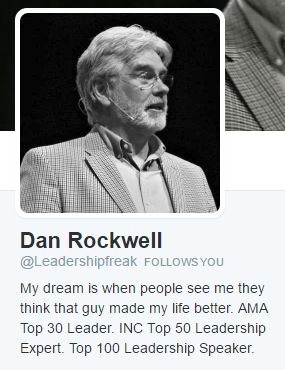
As I continue my search for Leadership resources and practical strategies to build strong teams and future leaders, I’m drawn back to one of my favourite blogs.  Leadership Freak  by Dan Rockwell designed, as he noted in his info, to empower leaders 300 words at a time.  And that’s what I’ve come to appreciate and am always working at improving.  The ability to shTwitter Picare useful information in a concise yet engaging fashion.  It’s what Dan Rockwell does each day.

Since January of 2010, Dan Rockwell has been sharing his ideas on leadership ranging from how to deal with underhanded resistance to servant leadership and coaching to name a few. Each offering ways to reflect on and move forward as a leader. If you are a regular reader you will also find there are opportunities to listen in to guest speakers, as well as, great recommendations for leadership resources.

So if you’re wondering about a topic and what thoughtful read that will get you thinking, the Leadership Freak blog is a great place to start.

(Image Twitter Screenshot – July 2016)


Switch – Why you want to add this to your leadership toolbox.

A Summary of

Switch How to Change Things When Change is Hard

By: Chip Heath and Dan Heath


While not specifically directed at the concept of leadership, Chip & Dan Heath shared straightforward strategies for dealing with change and making it last.  It’s a challenge often faced by leaders, whether you are leading a cross country team, a class of students or your own family.  Making the change not only stick but have noticeable results is a skill worth learning.  Written to include practical strategies enhanced by real life examples, the Heaths offer practical ways to address the changes in your life based on research compiled from a variety of disciplines including psychology and sociology. It’s one of my all time favourite audio books.  The stories keep you engaged and help you to remember the key points.

The Heaths explain that everyone of us has two sides and use the comparison of a rider on an elephant to help you better understand how the brain works.  The rider is the rational part and the elephant is the emotional response.  In order to make change stick you need to get the rider and elephant going in the same direction.  Chip and Dan Heath outlined three key parts to successful change.  First, you must direct the rider.  I was drawn to the research they shared that when we focus on the bright spots or what’s working, we begin to see more ways to make the change work.  In short, focus on the positive examples.  Yes we can learn from the negatives but research shows focusing on the positives will generate better results.

Second, you have to motivate the elephant.  You will exhaust the rider if you don’t get them both going in the same direction.  Willpower only lasts so long.  The Heath’s noted several examples, but what stuck in my mind is that identities can change.  What type of identity and growth mindset is linked to your team?  The innovator identity of Brasilata stands out in my as a powerful example of how changing the mindset of your team can truly transform the long term results for the better. What type of growth mindset do you carry with you?

Lastly, you have to shape the path.  Do you realize that it’s not always the people that are the problem?  The Heaths noted Lee Ross’s fundamental attribution error research that is our “inclination to attribute people’s behavior to the way they are rather than the situation they are in” (p. 180). If you tweak the environment, the situation, the context… how people respond changes.

It’s well worth the page turning read.  The Heaths share big business, education and personal examples of how these strategies can make a difference.  As with anything these research based suggestions aren’t a quick fix and you have to commit to leading the change; however, this book offers practical ways to reflect and shape the change happening around you.  Whether or not you want to do the work is up to you.

Leadership Connection:

  • Leaders are often called upon to lead the change or implement the initiatives.  Regardless of whether or not you are the president of the company or an employee, the skills you use to cope with change ripple out to those around you. The opportunity to build your toolbox and help others grow through change will change your relationship with others.
  • As an educator, the strategies offered here are applicable within a classroom, school or division level; moreover, teaching your students to navigate change will be one of the most valuable skills they can take with them into their future.

Additional Resources:

  • At heathbrothers.com you can register for a variety of free resources that highlight key aspects of the book including a summary pdf, workbooks and podcasts.

Heath, C., & Heath , D. (2010). Switch How to Change Things When Change is Hard. Toronto: Random House Canada.


The Super Better Leadership Connection

Why is Super Better on a list of leadership resources?

A Summary of Super Better


By: Jane McGonigal

Super Better is one of my all time favourite reads because it changes how you look at the world around you and the opportunities you have to build your resilience. Based on the idea of being gameful, Jane shares her own story of how the Super Better game began as Jane the Concussion slayer in response to her own severe concussion and subsequent depression.  In her book and TED Talk, Jane shared how she used the science of games to create her own daily challenges to help get better.

TED Talk – The Game that can give you 10 extra years of life
(Interactive Transcript)

Built around the idea that improving your physical, social, emotional and mental resilience will improve your overall health and perspective on life, Super Better uses strategies found in gaming to increase your strength, happiness and resilience (p. xi). Did you just make a face when I mentioned gaming?  Don’t worry it’s not going to try to make you into a gamer rather it pulls from rigorous game based research, which means using what science has learned about gaming to help you become healthier.  Can you play it as a game?  Yes – there’s an app for that – SuperBetter.com. What you don’t want to miss is the wealth of strategies offered that have the potential to improve your resilience.

51ohurxogil-_sx327_bo1204203200_McGoningal (2015) noted in her opening pages, “there’s a lot of evidence that it works” (p. xi) including a “randomized, controlled study conducted by the University of Pennsylvania…[and] a clinical trial funded by the National Institutes of Health and conducted at Ohio STate University  Wexner Medical Center” (p. xi). A summary is available at the end of the book and online at showmethescience.com

Are you intrigued?  Here’s the very quick rundown of SuperBetter. Based on the idea of post-traumatic and post-ecstatic growth… which means why do some people grow stronger after extreme stress while others are weakened (p. 7).  McGonigal noted 7 key ways of “of thinking and acting that contribute to post-traumatic and post-ecstatic growth. And they are all ways that we commonly think and act when we play games” (p. 7-8).

(Image Screenshot from Amazon)
  1. Adopt a challenge mindset
  2. Seek out whatever makes you stronger and happier
  3. Strive for psychological flexibility
  4. Take committed action
  5. Cultivate connectedness
  6. Find the heroic story
  7. Learn the skill of benefit finding
    (SuperBetter, p. 8-9)

The SuperBetter method helps you learn how to challenge yourself in a variety of ways that you can easily do each day.  My favourite are “power-ups” – “any positive action you can take, easily that creates a quick moment of pleasure, strength, courage or connection for you” (p. 160).  McGonigal goes on to share that these will change your “biology in extraordinarily important and long-term ways” (p.160) making you less vulnerable to stress.

Power-ups are easy and can be physical, social, emotional or mental.  It can be standing up and taking 3 steps or snapping your fingers 50 times.  Building resilience helps your body withstand stress (physical p. 14);  “improve focus, motivation and will power” (mental p. 15);  increase your ability to focus positive emotions (emotional p.16); and find support in the networks around you (social p.17).  The book is filled with examples of power-ups and the online game includes more designed both by McGonigal and other players.

Power-ups build into quests – things may push you outside your comfort zone but are achievable in the next 24 hours.  It just like teachers would do for their students.  Challenge them to stretch to what is in reach but just outside where they’ve been before.  Then you build your network of allies….what leader doesn’t need a team of strong followers.  You go on to name your own bad guys and develop your own super hero name in the ultimate search for your epic win.  Even if you are shaking your head right now, remember that each aspect has the science behind it… including giving yourself your own secret identity.

So why talk about Super Better in a class that’s focusing on leadership? As an educator and a home based business team leader, I see many benefits to building these strategies into your daily life.  Can you imagine if we explicitly planned in schools to create more resilient students? Not that teachers don’t already do this, but what if we purposefully use research based strategies to build resilient learners.  Could you imagine the toolbox of resilient strategies students would have?  Can you imagine the ripple effect?

Whether you are a team leader in business or a teacher in a classroom, what you do and how you do it affects your followers.  It affects how your followers are going to respond to tough times and hard decisions, which in turn affects how they support you as a leader.  Leadership is more than having the characteristics of a leader, it’s about how you can give back to your team members.  After all, a resilient team that builds on the strengths of each other and forms a strong supportive network is more likely to produce positive results.

And so as I write this near the beginning of my ETAD 898 – Independent Study in Leadership, I see connections building to theories of servant and transformational leadership.  I think SuperBetter offers a concrete, research based way for you to become more resilient and in turn you have the opportunity to share those strategies with those around you.

My daughter is 7 and we’ve started playing SuperBetter together.  It’s a great way for us to learn how to live healthier together.  Even better, she reminds me to do our power-ups and when she’s had a tough day we stop for a moment and look at all the positive power-ups that she’s already done and at ones that will help us feel better.

So whether you play the game faithfully or learn some simple strategies.  There’s always something to learn from the SuperBetter method.


SuperBetter: A Revolutionary Approach to Getting Stronger, Happier, Braver and More Resilient – Jane McGonigal

McGonigal, J. (2015). SuperBetter: A Revolutionary Approach to Getting Stronger, Happier, Braver and More Resilient. New York: Penguin Press.