
A Review of
Talk Like TED: The 9 Public Speaking Secrets of the World’s Top Minds
By: Carmine Gallo
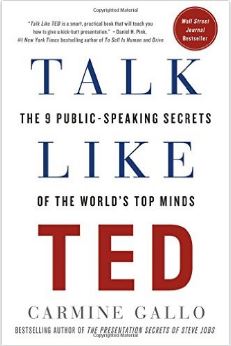 It was one of those books that kept appearing in my amazon and audible suggested reading list. I’m a avid consumer of TED Talks, TED radio hour and local TED X events. I love learning and 18 minute TED Talks are just enough time to learn a little bit that will hook me into learning more. I’ve listened to hundreds of TED Talks as I drive from one location to another or weed the garden. And you know when you find the one TED Talk that changes your perspective or just makes you stop what you are doing and think. Sometimes I can’t wait to share what I’ve learned with friends and colleagues. I’ve often wondered why I can explain the concepts and tell the story of some TED Talks like I just listened to them, while others were interesting but I can’t remember them for very long.
In “Talk Like TED,” Carmine Gallo shared why some talks go viral and the ideas stick. While a sticky idea is an important part of getting people to remember the information, it turns out great public speakers employ several key strategies. Gallo explained that ideas are the currency of the 21st century and if they are delivered well, they can cause lasting change.
Based on his extensive analysis of TED Talks and presentation strategies, Gallo shared 9 key strategies that will change how you share information in a presentation. Here’s a very quick overview as I highly recommend you listen to or read his book. It’s filled with practical strategies.
- Unleash the Master within – Find what you love to talk about and share your inspiration. Your audience will know if you don’t love what you are talking about. Your passion shows not only in your voice but in your body language.
- Tell stories – Gallo noted brain research showed that stories better engage listeners. They help you connect with your audience by sharing a piece of you.
- Practice – There’s no way around it. Great TED Talks are the result of hundreds of revisions, test runs and practice. They become a conversation not a lecture.
- Teach your audience something new – Humans love novelty and our brains will tune in to learn new things. So teach them something they didn’t know before.
- Deliver jaw-dropping moments – This means sharing something that causes a strong emotional response. We encode emotionally charged memories better and more accurately. So help your listeners make a connection.
- Use humour without telling jokes – It better connects you with your audience.
- Stick to about 18 minutes – Much longer and you overload people’s memories and they won’t remember what to share.
- Favor pictures over text – we are more likely to recall a picture that a text based bullet.
- Stay in your lane – Share your story and what you’ve learned. People will connect with your authenticity.
Gallo shared personal experiences and numerous TED examples to explain the 9 strategies in a detailed and engaging way that not only makes you think about why some speakers are better able to draw you in, but how you too can share your ideas.
Leadership Connections:
- Being a leader means sooner or later you are going to have to speak in front of other people in order to share your ideas. Sharing ideas that connect with an audience requires more than making it up as you go along. Keeping these 9 ideas in mind can help you shape and refine your presentation skills each time you speak to an audience.
- Teachers address students each day. Understanding how to share ideas not only increases the chance that students will remember but it also models presentation techniques. Just think back to the teacher you remember the most. I’d wager it’s not the content specifically you remember but how they delivered the content or engaged you in learning that sealed it in your memory.
- Enhancing your ability to communicate increases the chances that your message is not only heard and understood but that it’s remembered. Clearly communicating where you are going and how you are going to get there will move your followers forward.
Gallo, C. (2014). Talk Like TED: The 9 Public-Speaking Secrets of the World’s Top Minds. New York: St. Marin’s Press.
Image – Screenshot of the cover from Amazon.ca
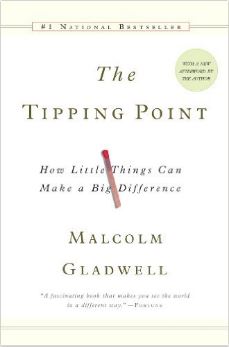 Just as the title promised, Gladwell explained how it’s the little things over time that make the difference and in the end cause the change to tip. Despite being written in 2006, the basic ideas still resonated strongly with me and added to my perspective of how change comes to be in the world around us. As leaders, The Tipping Point reminded us to appreciate the people in our network and value the the small changes because in the end it’s more often the combination of small consistent changes that have shaped the world around us than large sweeping initiatives.
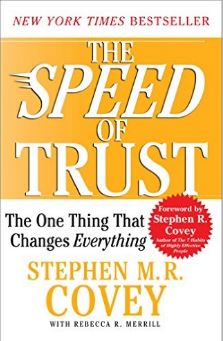 Thanks to the Entre Leadership podcasts I was introduced to the value of The Speed of Trust and as Stephen M. R. Covey says it really is the one thing that changes everything. Though not directly mentioned in many leadership theories, it underlies the strength and willingness of your supporters to follow you and produce continuing results. Covey concluded, “I have come to this simple definition of leadership: Leadership is getting results in a way that inspires trust” (p. 40).
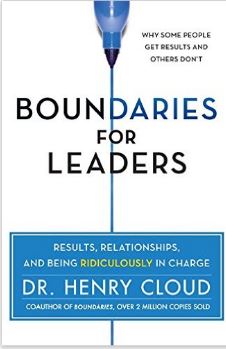 I came across Boundaries for Leaders after listening to an Entre Leadership podcast on the importance of mentors. What really drew me into the book was the idea that learning to lead required us to better understand how the brain functions.
  What's Your Story?