What do you need to know before you Google?

Do you have to know what you are looking for in order for Google to have the answers?

All I can say is Wow!  What an intense evening of debate for our EC&I 830 class. Both teams dug into the topics and shared points that made me think twice about whether or not schools should be teaching anything that can be googled?

Google
Screenshot of Google Search

Do you need to?

It’s an interesting question and one that deserves more than just a passing thought.  We are educators and what, how and why we teach the way we do matters to our students.  It impacts how they think about the world.  

 Both teams raised valid concerns that made me think about what we know and what we take for granted in the age of instant access.  While I still come back to the idea that it’s not about the technological tool but rather how you use it to encourage deeper learning. The points raised made me think about when automaticity is appropriate and necessary to lay the framework for deeper, critical thinking.  And just because we can google it, doesn’t mean that we should.

I have to admit I was swayed by the debate statement.  Should we be teaching anything that can be googled… but perhaps the question really is should we be assessing things that can be googled?  To me it’s not so much how you access information, it’s what you do with it once you have it.  

Heick’s article, “How Google impacts the way students think” raised several key points that made me wonder…..

  • When we are curious do we stop at the first website that google gives us?
  • How many people move beyond the first link?
  • Why do some move beyond the first link and continue to dig deeper while others are content with the first explanation?

Have you ever stopped to think about why you stop at the first link you find?

→ If I’m just looking for a confirmation of the concept then I tend to stop if the first link confirms the knowledge that I have.

→ If I’m truly researching a topic, I follow one link to the next until I feel I’ve reached my goal that or I’ve been distracted by various links along the way…. I wonder how much of my research is shaped by Google’s knowledge of me?

Speaking of which I came across this Knowledge Graph Video, which talks about how Google is attempting to make even more connections for you when you search.


map with car
Fidler Jan Morguefile


Heick also asked if we think of google as a destination rather than just part of the journey? As if Googling is easier than thinking?

Does Google as Heick suggested promote information independence as opposed to knowledge interdependence?

It takes me back to the question that students often ask….

pen and paer
Cohdra – Morguefile

If I have to cite everything I find then when is it actually my words that come through?

 While helping students and people in general understand the value of intellectual property and giving credit where it’s due, is an issue that needs to be addressed… that’s a different post.
Does googling promote the development of your own voice?
Who is responsible for weaving the knowledge connections together?
When do all those separate bits and bytes of data become knowledge
or evidence of learning?

It’s the ongoing conversation I had with students when we talked about how they could share the story of their learning.  It’s up to the student to analyze, evaluate and create meaningful connections.  The points they choose to cite, the order they share the information in and the stories they connect them to in their life — that’s what we need to learners to think about. So as one of my classmates aptly pointed out, just how much information do you need to know in your brain to actively understand all of the information we encounter everyday.

Just pause for a moment and think about all of the knowledge and skills you have stored in your brain that’s reached a level of automaticity — you don’t have to think about it you just know it….

  • Did you have to think about where the letters were on the keyboard to type your response?
  • If you see a red octagon…. What does that mean?
  • Can you read these words?  If you are a fluent reader, chances are you didn’t have to stop and think about decoding the words. You know your letters and sight words.

letters

Do you wonder just how ingrained our learning is?

Try the Stroop Test for a quick reflection on just how deeply words are encoded into our brain. You can try out the Stroop Test here – follow the instructions and reflect on just how much our brains are programmed to respond in certain ways.

    • While the Stroop test measures interference in the types of information your brain is receiving, it’s interesting to think about how many skills and pieces of knowledge we take for granted.

As an interesting side note, I spent Wednesday in a Diversity Education Teacher inservice and we were learning about executive functioning of the brain.  Our Ed Psych, shared that when we know our basic math facts and letters (i.e. we’ve learned them to the point of auotmaticity), when we need to access that knowledge the back part of our brain goes to work.  For learners that struggle with basic facts that aren’t automatic the brain activates parts of our frontal lobe to try and help.  Eventually students can figure it out but the costs of accessing and processing the info is much higher.


The video, How the Internet is Changing Your Brain – highlights unless we actively work with information in our short term memory it is not going to be encoded into our long term memory.  “The more we use Google, the less likely we are to retain what we see.” (para. 3). Or is it really the rise of of Connectivism.  The idea that learning takes place not only in the connections that we make with information internally in our own brains based on the experiences we have, but that “learning (defined as actionable knowledge) can reside outside of ourselves (within an organization or a database), is focused on connecting specialized information sets, and the connections that enable us to learn more are more important than our current state of knowing” (Wikipedia – Connectivism).

In the end, we know that learners today have more access to information than ever before through tools that can make knowledge acquisition almost instantaneous.  The true art of teaching and learning will be to find a balance.  As Danielle’s blog post noted, whether it’s searching online or using our memory, the task or reason needs to be purposeful if we are going to fully engage the student in making meaningful and lasting knowledge connections.  After all, it’s just data unless we actually make meaning from it.

If we are assessing on questions that can be googled or looked up in a book, are we really assessing students on what they know or on their research skills?  Is it really Google that’s causing us to have shorter attention spans and transfer less knowledge to long term memory or is it a the evolution of a connective technology that increases our access and our cultural learning practices haven’t caught up?

What do you think?….did you just google the topic 🙂
 

Who really enhances learning in the classroom?

Is it really technology in the classroom that enhances learning?

Or is it

the people and how they use the technology that makes the difference.  It’s like saying that any social media tool is inherently good or bad… the code itself isn’t bad … it’s how we use it that impacts our learning and the experiences of others around us.

What or rather who is it that enhances technology in the classroom?

I think in the end it’s not so much about the technological tool that you have in the classroom it’s about what you do with the technology you have.  As I listened to the debate and reviewed the shared articles, our technology discussion reminded me of a motivational workshop lead by Rick Lavoie.  He reminded us that we are among the first generation of teachers that didn’t grow up in the same world as our students.  Yes we still attend schools that resemble the traditional brick and mortar schools of years gone by but life has changed or maybe it’s that we have added a variety of ways to interact with others that has changed?

How many educational tools have come along since you were in high school or even university?

Click on the question above to share some of the technological changes that stand out for you.  Check out the responses here.

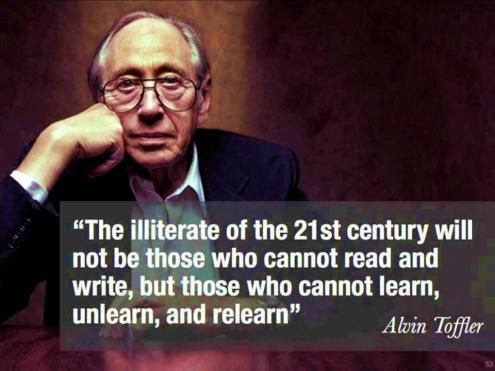
Today’s students live in a connected world in which interaction happens in a variety of ways (face to face, online or through social media).  So how do we prepare ourselves for our connected world filled with technology that has the potential to change how we learn?  Lavoie cited Alvin Toffler,

toffler
Source  ―  Alvin Toffler

Those 3 words – Learn, Unlearn & Relearn –  have stuck with me.  So how do we as educators refine our learning environments and strategies to challenge students to think about how they learn, what digital tools enhance their learning and to make meaningful connections to their learning?

Does technology in the classroom make a difference?
I believe it all depends how you use it.

Perhaps it’s committing to be a life long learner, doing the best you can with the technology you have and learning from the students as you go.  Although that is sometimes easier said than done.

It’s about what you do with what you have….

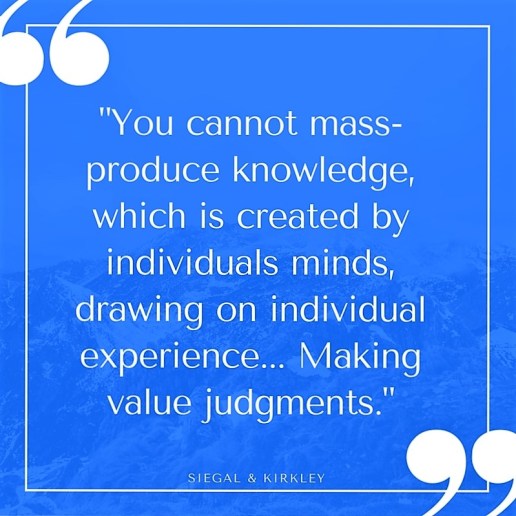
  • Siegal & Kirkley remind us that the internet gives us 24/7 access to massive amounts of information or data and note Roszak’s comment:

You cannot mass-produce knowledge, which is created by individuals minds, drawing on indvidual expereince... Making valude judgements.-

(Web Based Instruction, p. 263-264)
(Image created with Canva)

The source is old 1997, but the comment still raises a valid point.
It’s just information unless we do something with it.

I have to admit.  I’m a firm believer in the value of integrating technology into the
classroom, but with that comes the acknowledgement that technology is just a tool.  

sw_BacklitKeyboard_FFP10029
JPPI on morgueFile.com

Unless you know what to do with the device, it’s not going to be an effective or productive learning tool.  It’s really about educators taking the lead and demonstrating how technology can be a useful tool.  It’s about how teachers integrate the tool into their classes, so that ultimately we don’t talk about the pencil and the eraser as these special tools to help students learn.  It’s about learning and choosing the technological tools that best support your learning needs. Pen, pencil, laptop or mobile device. 

As an interesting aside….
The “Does Technology enhance learning debate” isn’t particularly new and thanks to Dr. Marguerite Koole in a recent conversation for sharing the pencil and eraser example.

pencil.jpg
 

Jentosoi morguefile.com


While we take for granted the fact that most pencils come with erasers, it was at one time a revolutionary idea; however,

“school teachers feared an increase in carelessness in children’s work due to the extra appendage on the pencil.  This may have been true but it seems that the ability to work faster and being less nervous about making an error has only increased productivity, and the pencil has become one of the world’s most useful and popular writing tools.” (Phillips, 2010)

As I was reading through the blogs this week, I think Kyle summed it up well in his post, “The concerns about these distractions are certainly real and we as teachers must be mindful of them.  However, with proper training and education, the benefits of technology are so vast.”


So how do you know what to do with the technological tools you have?

Like Kyle mentioned,  along with the disagree side of our debate, purchasing the physical technology is only one part of the equation. Supporting thoughtful, relevant, ongoing PD is not the norm.  What type of implementation model is being used to support the people part of the process?  Alec Couros shared that a 50/50 split of spending on devices and PD is recommended, while Carlson (2002) encouraged a 60-40 split. Ongoing discussion comments revealed, not surprisingly, that the other half of the budget is not spent on PD.

How often is technology related PD sustainably built into the implementation?

How often do we considered a model of instructional design such as ADDIE  to help guide and process our thinking?  The ADDIE model encourages us to Analyze the needs, the audience and our learning goals.  Purposefully DESIGN a structure, method and strategies that we can DEVELOP into relevant, timely training.  Next we create a strong path to implement the training and EVALUATE the effectiveness so that necessary updates can be useful.

What about Assistive Tech?

This model could help us purposefully integrate Assistive Tech into student learning.  As I work with teachers and students, there are many instances in which Assistive Tech can aid the learning of a student.  Whether it’s learning how to use a communication switch or a helping students access the supportive features of Google Read Write having access to the tech is only one piece of the equation.  Both students, teachers and supporting professional needs to consciously integrate the tool into the student’s learning plan regardless of whether it’s a formal IIP (Inclusion and Intervention Plan) or simply a tool that students can use in the classroom.  The effectiveness of the intervention is inextricably linked to the people in the student’s environment.  Teachers who are supported by professionals and school staff are more likely to purposefully scaffold the use of the tool into daily student learning.  It takes time to build the skill set and the environmental conditions in which a student can independently use the tool to aid learning and Adebisi et al’s article reminded us of a variety of Assistive Tech aspects to consider.

My only side note from my personal experiences with supporting assistive tech usage is to ensure you include the student and family in the process.  Because in the end, if the student refuses to wear or use the device…  it’s hard to effectively integrate it.

How has technology impacted my learning?

When I was teaching in my 1:1 hybrid classroom…

    1. The connections that my students were able to make to the concepts, how they were able to encode their learning and the ways they were able to share their ideas opened up.
    2. Did they have to use technology in my class? The opportunity was there for them but the most important part was making a decision about what tool worked best for them to learn.
    3. Did I encourage them to try out the new app, website or device?  Yes, I think you have to try it out before you can tell me that it doesn’t work.  It’s not so much about the tool as learning to think about how you learn (metacognition) and why you as a learner choose different strategies.
    4. It changed the playing field for my students.  In the informal data that I collected through surveys and reflection questions, one key point resonated with me.  A shy, student explained that when we were online, people actually listened and responded thoughtfully to her points.  She explained that they saw her ideas… they saw beyond their assumptions.

Personally, technology  has played a significant role in my personal learning.

Without technology, completing my masters two hours away from any university would be very challenging.  Not impossible but it would most certainly have affected my decision to start the program.  So for me it not only increases access to education but provides a way to actively participate and build a personal learning network. 

Audio books…

A rather simple technology has changed my travel time into PD time.  Life’s a bit crazy with a young child, a full time job, a home based business and masters classes.  The ability to access podcasts, books and online training as I drive turns traditionally lost time into learning time. 

So does technology enhance learning.…..it certainly can if you purposefully choose to embed it into the learning …. maybe one day we won’t talk about the technology… just the learning.


Interesting Articles that I came across during the creation of this post: