Summary of Leadership Styles in Synchronous and Asynchronous Virtual Learning Environments

A Summary of
Leadership Styles in Synchronous and Asynchronous Virtual Learning Environments


Article By
Stefano Ruggieri, Stefano Boca and Maria Garro (PDF)

There is a difference.  Face to face leadership is different than virtual leadership.  Ruggieri, Boca and Garro highlighted that while face to face leadership is established through physical presence including “body language, vocal inflection, eye contact and clothing” (p. 98) along with comments from inside the group. Virtual leaders are challenged by the technology. “The medium forces the leader to adopt other indicators to let followers know he/she is in charge, which include frequency of intervention, small delays between request and responses, being (almost) always available” (p. 96).  How you recognize the leader happens in different ways online.

Ruggieri, et. al. noted that virtual team research reinforced that transformational leadership develops higher levels of “trust, performance and job satisfaction compared to those of transactional leadership”(p.97) yet it’s still lower than face to face situations. Virtual communication occurs synchronously in real time through video conferencing or live chats or asynchronously at different times through discussion threads or email (p. 97-98). The authors noted text based communication as the most commonly studied medium. Text has many positives including the capability to enable many people to contribute at once (p. 98).

A good reminder for all of us is the caution that typing speed along with the ability to decode and read can significantly influence a person’s ability to participate, which may not be indicative of their ability to contribute to the group but of a language barrier (p. 98).  An important reminder for all of us as educators of EAL students and for team leaders with large cross country teams.  Our preferred medium may be text but not everyone may be able to fully participate and contribute.

The authors explained Henri’s method for examining the 5 dimensions of the learning process through online communication because not only are the number and frequency of messages important, but the meaning and learning embedded within the exchanges. Ruggieri, Boca and Garro studied synchronous and asynchronous communication within text based problem solving groups with transactional and transformational leaders.

The researchers noted online groups led by a transformational leaders resulted in”an increased level of cognitive and metacognitive communications” (p. 100) which in turn led to leader behaviour which encouraged self awareness and personal growth, as well as, enhanced levels of “proactive personality and team identification” (p. 101).  Because the transformational leader builds the skills of the followers, they “have the ability to influence the emotional climate of the work group” (p. 101).  The chosen interactive medium is a tool that also shapes group communication differently than face to face interactions.

Overall, Ruggieri, Boca and Garro provide an insightful look into the world of virtual leadership and how your online leadership style has the potential to affect motivation and effectiveness of your team.

As a team leader, I’ve often wondered how to lead online and this article provided an interesting look into how technology impacts our communication, leadership and in turn our team results.  Whether it’s a large scale home based business Facebook group or a ETAD discussion forum, leaders will emerge.  The groups I’ve most enjoyed follow a transformational style where I’m inspired to join in and participate rather than because I have to.  As I reflect back on 9 online classes, some of our most insightful, interactive and asynchronous conversations have developed in our groups with transformational leaders that encouraged us to share our ideas without the fear of being wrong.  For the real learning is in the sharing of and reflecting on ideas.  You don’t grow unless you share, make connections and think more deeply.


Ruggieri, S., Boca, S., & Garro, M. (2013, October). Leadership Styles in Synchronous and Asynchronous Virtual Learning Environments. The Turkish Online Journal of Educational Technology, 12(4). Retrieved from http://files.eric.ed.gov/fulltext/EJ1018022.pdf


A Summary of Leadership: Current Theories, Research, and Future Directions

A Summary of
Leadership: Current Theories, Research,
and Future Directions


By Bruce J. Avolio, Fred O. Walumbwa, and Todd J. Weber

Avolio, Walumbwa and Weber provided a detailed integrative review of leadership theories and current research paired with suggestions for future research.  The authors reflected on key leadership theories including:

  • Authentic Leadership
  • Cognitive Psychology
  • New Genre leadership
  • Complexity leadership
  • Shared, Collective or Distributed leadership
  • Leader-Member Exchange
  • Followership & Leadership
  • Substitutes for Leadership
  • Servant Leadership
  • Spirituality and Leadership
  • Cross Cultural Leadership
  • E-Leadership

Interestingly, Avolio, Walumbwa and Weber (2009) noted a holistic trend in leadership research that has shifted to include a stronger focus on “not only the leader, but also on followers, peers, supervisors, work setting/context, and culture” (p. 422), as well as, positive forms of leadership. Examining the actual process of leadership and alternative ways to examine leadership were also mentioned.  The authors commented that we are likely to see a greater use of mixed method research design including a greater emphasis on qualitiative data collection (p. 441-442).

Are leaders born or made?

Avolio et. al. noted preliminary evidence suggested 30% of leadership style is genetic.  The other 70% depended on life context including your home life and those around you at work (p. 425).

Does it matter if you are more interested in learning about leadership?

Avolio et.al. explained one’s motivation to learn or developmental readiness does impact your learning.  Individuals who are are more motivated will “embrace trigger events that stimulate their thinking about their own development as an opportunity tot improve their leadership effectiveness” (p. 426)

The authors explained the role of the follower is an important area for continued reasearch.

Connections:


– In “The Switch” Chip and Dan Heath talk about the importance of people adopting identities.  Avolio cited the Lord & Brown (2001) model of how leaders can influence follower behavior.  The first was relating to the follower’s values.  The second point noted leaders “activating a specific identity to which followers can relate, creating a collective identity” (p. 427).  Identities change over time so the identity leaders choose to share can impact the effectiveness of the change that they are trying to implement.

Leadership Connections:

This article introduced the concept of E-Leadership or virtual leadership “where individuals or groups are geographically dispersed and interactions are mediated by technology.” (p. 440).  Avolio et. al. explained that e-leadership comes with it’s own set of challenges including different time zones, communication challenges, variance in hardware and software, as well as, local priorities (p.440).  Furthermore, traditional leadership models, which as Zigurs noted are built primarily on face to face interactions, may not fully explain how virtual teams work (p. 440)

Business Link:

  • Color By Amber link – Avolio et.al. explained shared leadership as “an emergent state where team members collectively lead each other” (p. 431). The authors noted that this type of leadership develops throughout the lifespan of the team and further develops the interpersonal relationships of the team members. Because Color By Amber launched in Canada in August 2014, I had the opportunity to be part of the launch.  This included the opportunity to work with leaders across Canada.  In response to team member questions and the desire to grow a positive sharing culture where team members empowered each other, our Canadian leaders opted for a culture of shared leadership which continues today on our Canadian Team Facebook group.  It’s not a hierarchy.  It’s a culture of sharing regardless of upline, downline or a different team’s line. The purpose is to help each other grow stronger and provide better service to our customers.
  • The section on e-leadership is one that I am currently pursuing.  I wonder as the authors noted how does e-leadership work?  How do you build the know, like and trust factor?  This article was also written in 2009, which means that there are tremendously different types of technology available to facilitate face to face distance interactions.

Overall this article provided a detailed, academic, overview of different theories of leadership and related research.  I appreciated the author’s future focus summaries which pointed out areas where more research is still needed.


Annual Review of Psychology

Vol. 60: 421-449 (Volume publication date January 2009)
DOI: 10.1146/annurev.psych.60.110707.163621

PDF: http://www.annualreviews.org/doi/pdf/10.1146/annurev.psych.60.110707.163621

What’s Leadership anyway?

An Overview of
Understanding Your Leadership Style 
By Chris Laney


Laney offered a brief overview of Goleman’s 6 styles of leadership (commanding, visionary, affiliative, democratic, pace setting, and coaching) and asked the reader to reflect on their style of leadership. He mentioned transformational, charismatic, servant, transactional and symbolic as other styles that we often hear in the media.  He reminded us that regardless of which style you are the more important piece is being flexible in your style.  Being able to understand  your context will help you choose a style that meshes best with your audience.

Leaders are always growing and reflection is part of that process. Have you thought about what kind of leader you are?


Laney, C. (2015, November 23). Understanding You Leadership Style . Retrieved from Linked In Pulse: https://www.linkedin.com/pulse/understanding-your-leadership-style-chris-laney

Summary of Skills You Need – Leadership Website

An Overview of
Skills You Need – Leadership
(Website)


This website explains both the traditional and more recent definitions of a leader, as well as, summarizing Daniel Goleman’s 6 styles of leadership (Coercive, Pace-setting, Authoritative, Affliative, Democratic & Coaching).  The website goes on to suggest steps to develop your leadership style, which includes a reminder that “the best leaders create other leaders, not followers” (Develop Your Leadership).  Ethical leadership is covered in the next section and draws from Stephen Covey’s four levels of principle centered leadership and suggested the concept of inside out thinking will change your perspective.  Leader or manager?  Have you stopped to think about the difference?  This website goes on to explain that leadership is not the same as management. There’s a difference in perspective and how we think about the challenges we face.  While many leaders are managers, not all managers are leaders.  The website explained a brief overview of leadership theories and how they have evolved since the early 1900s. The leadership section wraps up with an interesting overview of what it means to be an entrepreneur and the skills most often demonstrated by entrepreneurs.

This website offered a quick overview of leadership and its various components.  Each page offered links to further skill development within the larger skill development website. Pages often included embedded advertisements along with the opportunity to purchase more detailed books/training from the website. Regardless of the ads and option to purchase this website provided an interesting introduction to leadership and offered connections to other research.

I found the entrepreneurship section interesting as I’m also a home based business owner and could relate to the aspects mentioned. In the entrepreneurial skills section, the writers quoted Howard Schultz, Chairman and CEO of Starbucks, “I think if you’re an entrepreneur, you’ve got to dream big and then dream bigger” (Skills You Need – Leadership – point #3). It reminded me of what Talley Goodson, Founder of Color By Amber, shared with us on our last evening in San Cristobal, Chiapas, Mexico. We had just spent 2 days meeting and learning from the artisans that create our intricate, Mexican interlayers.  As he shared part of his life’s journey, how he built the company from scratch and why what we do makes a difference, he said anyone can make a difference.  The reason that some people have a bigger impact is because they dream bigger and bigger.  They see the vision on a broader scale and they go for it.

Leadership depends not only on the individual but your team and the changing contexts that we live in.  A true leader understands the situation and their team and consciously or unconsciously chooses a style that best matches the needs of the situation.


SkillsYouNeed (2016) What is a Leader? [online] available at http://www.skillsyouneed.com/lead/leader.html (Accessed July 7 2016)

Should You Unplug from the tangled “WEB” we weave?

Wow!  It’s crazy how fast a spring class goes and how much you can learn when you take the time to step back and reflect.  I think that’s been my favorite part of ECI 830 – Contemporary Issues in Educational Technology.  The chance to talk about Ed Tech issues that are shaping our world with thoughtful, creative educators who are passionate about learning.

Our topic this week asked,

Have we become too dependent on technology and what we really need is to unplug?

cell-1344985_960_720Pixabay (TheHilaryClark) – CC0

It’s June and as educators, I think we are all counting down the days until we can unplug and step back and take a breath. Not because we don’t love what we do, but because whether tech related or not we all need a chance to recharge.  It helps keep us healthy.  Perhaps the question really is do we actively make time for ourselves?  Is it about unplugging or setting aside a few minutes in a day for you to recharge? Our devices need time to recharge maybe we do to 🙂

8bcaf3662f33c28e98e1cbf38e943aaf-610x475Image from 14 End of Year Memes That Any Teacher will Understand

I reflected in my summary of learning that how we choose to use technology impacts us directly, but as I continue to reflect it always comes back to balance.  And just what is balance?  In Dre’s final blog post, he talked about hanging out in the grey areas – the space between – finding moderation.

It’s how I choose to shape my life. It’s the small choices that I make each day that over time shape the life I live.

Chip & Dan Heath in The Switch and Malcolm Gladwell in the Tipping Point both noted the significance of context and how it’s often the small things that cause a change to tip one way or another.  It’s also about how you shape the path (context)… so if you aren’t thinking about it just who is shaping your ed tech path?

It brings to mind the story of Two Wolves told from a Grandfather to a Grandson…
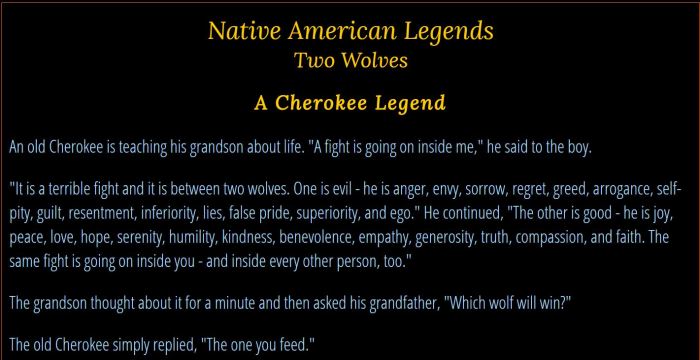
Two Wolves
Screenshot from First People – The Legends

There’s always multiple perspectives to each issue, the one you feed will get stronger.  I think the scary part is how often do we stop and think about which wolf we are feeding? I know that this class has taken my Ed Tech reflection to an entirely new level.  In fact, I think it’s taken my ed tech interactions to a whole new level.  When I travel with my consultant colleagues to our various schools, we have time to talk in the car.  My colleagues are very supportive (I’m fortunate to be surrounded by SLPs, Counselors, OTs and Ed Psychs on my travels.  Talk about a amazing support team, outside of family and friends;)

My point is when you start the conversation…when you choose to step in and talk about the issues, you never know how it will ripple out and who will be impacted by your conversations.

Think about the number of different people you interact with on a daily basis – students, parents, teachers, Admin, support staff, community members….At one point in my teaching career I was seeing a minimum of 130 students a day.  The conversations that you have and your willingness to share your stories and your reflections matters. And those are just your face to face interactions, consider your online connections.  Think of the ripple effect… now consider if your conversations start a word of mouth epidemic… now there’s a potential tipping point (It’s a great read – Malcolm Gladwell’s Tipping Point).

I found this week’s spoken word videos are a form of communication that maintains my attention (it seems to be harder to do in the days of information overload).  I love podcasts and Ted Talks but the rhythm and rhyme of spoken word creates a engaging flow of ideas.  I was drawn in by “If this video doesn’t convince you to put down your phone, nothing probably will.

https://www.youtube.com/watch?v=AY4uWLOLKzU

He raises some thought worthy questions – Do touch screens make us lose touch?  We have large friend list but are we actually friendless?

Or in this case is the question more important than the answer?  Is it that it makes you stop to think for a moment?  And if it does resonate with you, will it cause a change?

Gary Turk also uses spoken word to encourage us to “Look Up” at the world around us.  Have we lost our connection skills?  What are we missing if we don’t look up?


Looking for an interesting read?   Margie Warrell‘s article “Text or Talk: Is Technology Making You Lonely?” explained how recent studies noted that “despite being more connected than ever, more people feel more alone than ever” (2012, para 2).  In fact the people who most reported feeling alone were in fact the most “prolific social networkers” (para. 2). She also shared that we have less close friends than we did 25 years ago and social media enables us to control our vulnerability and vanity…turns out that true connections require vulnerability and that means it isn’t always pretty. (Brene Brown‘s Daring Greatly – is an excellent read on the value of vulnerability).

binary-1327493_960_720Image from Pixabay – Geralt – CC0

Warrell suggested 7 strategies for building a “REAL” social network, I’d argue they are basic life strategies: (the bracketed comments are mine).

  1. Unplug (I’d say not just from tech but make time for you to recharge)
  2. Become a Better Listener (Always a good strategy)
  3. Engage in your community (not just online)
  4. Practice Conversation (Face to face interaction is more than words)
  5. Find Like Minds (Look around – who challenges you to grow?)
  6. Reconnect with long lost friends (go for coffee)
  7. Invite People over (Yes, but first I have to clean my house;)

Just this week I was talking with my colleagues and I mentioned how we had discussed the addiction to the internet in one of our many debates.  Interestingly, the counselors both mentioned that connection is the opposite of addiction and then they shared a comment that made me pause…. so what happens when we think we are helping someone’s addiction by taking away their device… how does that help them find meaningful connections? What determines meaningful?

Sophia Breene (2015) commented that “social media is the Green Eyed Monster’s preferred stomping ground” (Why Everyone Should Unplug More Often). It conjures up quite an image for me, but is FOMO (Fear of Missing Out) causing us genuine anxiety?  Don’t laugh, an Anxiety UK study noted

“if you are predisposed to anxiety is seems that the pressures form technology act as a tipping point, making people feel more insecure and more overwhelmed.  These finding suggest that some may need to re-establish control over the technology they use, rather than be controlled by it” (Anxiety UK, 2012).

smartphone-1445487_960_720
Image from Pixabay – geralt – CC0

So if you’re not thinking about how tech is affecting your life, who or what is shaping your life? And do you lead two separate lives (online and offline) or just one augmented life that now encompasses the digital world. Jugenson (2011) reasoned we “live in one reality, one that is augmented by atoms and bits… an augmented self” (p.3). As far as I know, life exists in the moment we are living in. The online affects the offline which in some cases affects the online.  It’s a tangled web we weave.  And so I return to the idea that it’s the choices we make that affect the life we live.  Social media and tech are part of the world we exist in.

 It’s your choice to mix the atoms and the bits, but the more important question is do you ever stop to think about how ______ is influencing your life and is that the life you want?  It’s your life, you get to write the next chapter. 
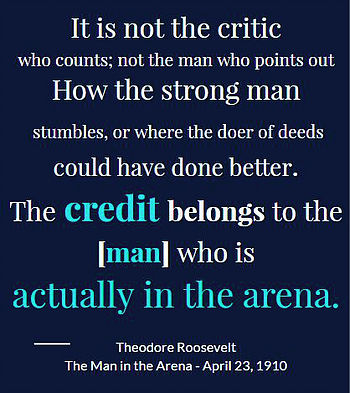
bfed9a_8bb1e1a124c049da987669c54296750bCreated using Canva


Thank-you to my ECI 830 classmates for stepping into the arena and sharing their stories.  It’s truly made for a rich learning experience.

way-1031336_960_720Image from Pixabay – Unsplash – CC0

So will I unplug? The end of July will mark an intense 23 months on the ETAD journey, starting a new business, working full time as a Learning Consultant and being with my family.  Have you ever heard your family and friends say I’ll see you after you finish your next class?   It was my choice, I shaped my own intense path.  I’m a self admitted workaholic that attempts to find balance each day (and I don’t always win – but I attempt to fight the battle and tech is only part of it).  It’s a work in progress.  By the end of July, I will complete my ETAD program which I’ve done completely online.

My favourite parts were when I went to Saskatoon to work on a couple group projects with classmates face to face…and the two times I attended class (Yes twice I attended Saturday classes).  It wasn’t the project or the class, it was that I had the chance to meet the people face to face.  It’s the fun of going to a PD event and meeting your online classmates in person.  And with that I pause… I’m a classic introvert and as introvert face to face interactions cost a lot more energy.  I think I’m more of an offline introvert online extrovert – it’s complicated (Collier, 2011, para 2).

I did attend one Saturday Grad Seminar on research ethics.  I opted to go in person, it was the loneliest seminar.  A room filled with people that I didn’t know from a diverse variety of colleges.  Everyone else appeared to know someone.  Sure I could have tried to add myself to a table but it was a month and a half into my masters journey and my network was all online and this seminar was for every new grad student at the university.  At the end of the day I wished I had taken it online…I might have met more people that way or at least found the ones that I only knew by their online profile pic and name.

So just keep in mind as you choose to use different types of technology and instructional strategies in your classes, each choice affects each of us differently.  So variety is important as it gives us all time to recharge and step out of our comfort zones once in a while.

Without the connectivty of online classes, I wouldn’t have gone back to school at this point in my life.  Two hours away from a university makes for long drives just to get to class. I’m glad I chose to complete my masters online, but how deep you go online has human costs.  I’m very thankful for a supportive family and close friends (no one does the Master’s program alone all your friends and family do it with you;) and that goes for my online friends that have supported me too.

So will I unplug? I have to say I’m looking forward to evenings where I can choose whether or not I engage online. There will of course be the mandatory summer hermit phase when I attempt to recharge (do all teachers go through this or just me?), but in the hermit phase I’ll still be online.  Will I disconnect from tech?  Not likely.  Will I attempt to be more conscious about my choices. Yes.  Will I think twice before I fall into a pattern?  I think this class has certainly opened my eyes.   In Go Pro, Eric Worre, explained that you become most like the 5 people you spend the most time with and these people will change as you grow and learn.  So I hope I’m aware of who’s around me and that together we will find ways to connect in and step out in a dynamic balance (equilibrium).  After all if you walk into a room and you are the smartest person there, you are in the wrong room.

Unplug or not, it’s really about the way to you choose to experience your life.  Will you leave a well documented online legacy or will family and friends be the ones to share your stories around the fire for years to come?

What will your story be?